Hire an API architect whose contracts partners can build on
An API architect sets the contracts, authentication patterns and versioning rules that every internal team and outside partner builds against, so a weak decision gets copied many times over. REST, GraphQL and gateway products appear on every resume, so the useful signal is how each candidate designs for a real partner request before your team spends time interviewing.
What the hiring manager needs from an API architect
The CTO or platform lead hiring an API architect wants partners to integrate without calling engineering each time, internal teams to stop inventing their own conventions, and breaking changes to stop reaching customers by surprise.
A partner wants to sign in and pull data
A large partner asks for single sign-on from its portal and an API for custom reporting. The architect decides which parts belong in OAuth and OpenID Connect flows, which in a reporting endpoint, and what to settle with the partner before anything is promised.
Two teams, two styles of API
One team returns errors in one shape, another in a different one; pagination and naming differ too. The architect writes a standard teams will actually follow and plans how to bring old endpoints in line without breaking clients.
A breaking change that needs a version plan
A field has to change type, and partners depend on it. The architect designs the new version, the deprecation notice and the period of running both, and checks who is still calling the old one.
Payloads that must be validated at the edge
Inbound files and requests decide who can access a service. The architect makes sure schemas, validation and error messages catch bad input at the API boundary instead of deep inside a service.
Where hiring an API architect usually goes wrong
- Promoting a strong backend developer into architecture
- Building fast endpoints is a different skill from designing contracts that outlive several teams. Interviews that test coding alone often reward the wrong strength.
- Testing knowledge of standards instead of their use
- A candidate can recite REST constraints or OAuth grant types. What matters is choosing the right one for your partner's real situation and explaining the trade-off.
- Ignoring developer experience
- An API architect who never thinks about reference docs, examples and error messages leaves partners stuck. You only find out by reading what the candidate writes for an outside developer.
- Overlooking API governance
- Rate limits, deprecation, security review and an owner for each endpoint are dull until they fail. A candidate who skips them in a design will skip them in production.
Real tasks from a Gateway assessment
These come from a Gateway assessment for a solutions architect, with the employer’s name taken out. Gateway writes every assessment from your own job description, so the tasks your candidates get are built around your role.
A design on a whiteboard, then a written note
Fitting a partner’s SSO and reporting asks onto the platform
After a discovery call, a large partner wants single sign-on from its own portal and custom reporting. The candidate has the account executive’s raw notes and the platform’s integration guide.
What a strong candidate did: Separated what the platform already supports from real new work, drew how the sign-on would flow, and listed the questions to settle with the partner before any promise is made.
Code, then a short handoff note
Fixing an eligibility mapper before handoff
A new employer client will send a nightly eligibility file. A prototype mapper was written from a generic template before the client produced a real file, and it decides who can enrol.
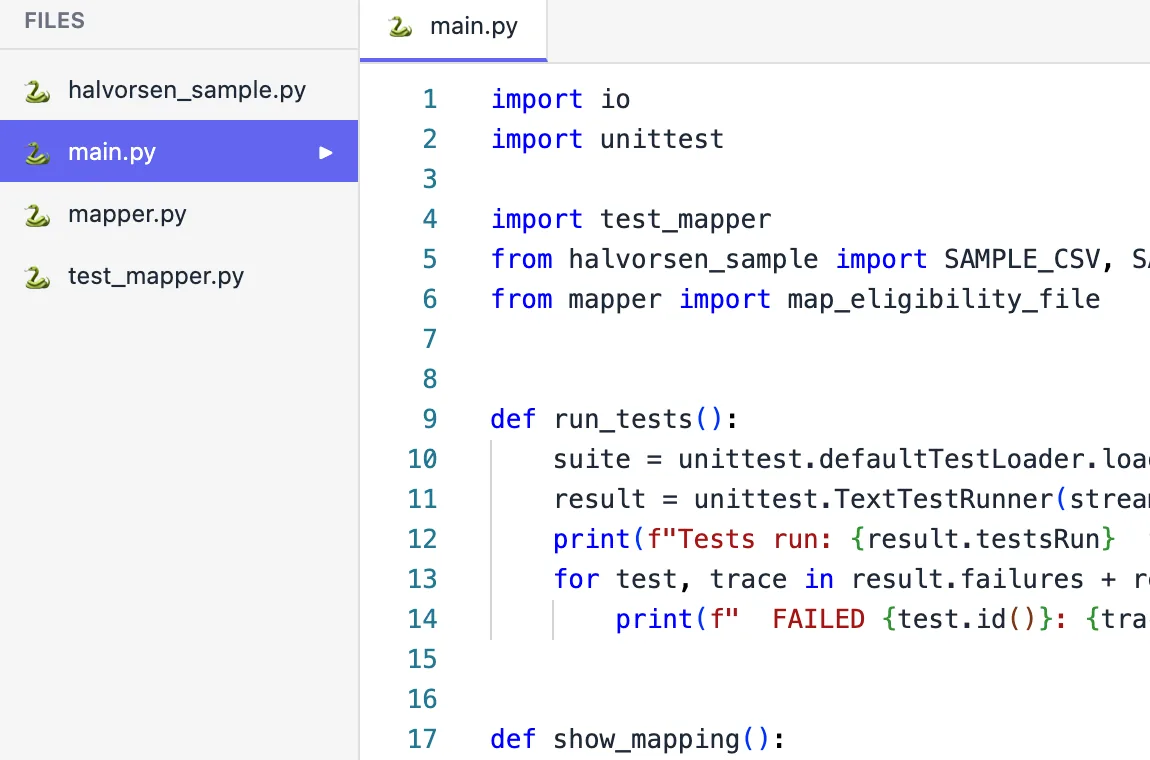
What a strong candidate did: Tested the mapper against the real file, fixed the cases where people would wrongly gain or lose access, and listed what the client must confirm.
How the decision gets made
With Gateway, API architect candidates work through situations from your job description: a partner's sign-on and reporting asks that need a design, and an inbound data mapper that must be fixed before handoff. They draw the design on a whiteboard, write code and explain decisions in a short note. Your platform lead sees a score and feedback for every skill, can open each design and file read-only, and only spends interview time on architects whose contracts would hold up with real partners.
See your next API architect at work before you meet them
Paste your job description and Gateway writes the assessment in about 5 to 10 minutes. Your team can edit every question before it goes out.
Questions
Can the assessment cover GraphQL or event-driven APIs instead of REST?
Yes. Name what the role works with in the job description and the situations follow it. Your team reviews every question first.
Can a candidate write an API specification as part of it?
A task can ask for a written design or specification in a document, alongside whiteboard and code work, and every answer opens read-only for your team.
Do we see how the candidate reasoned, or only a score?
Both. Each skill has a score and written feedback that explains it, and the candidate's actual whiteboard, code and notes are there to read.
Can candidates use an AI assistant to draft specs?
If you choose an AI-assisted assessment, yes, and your team sees how the candidate worked with the assistant. That is worth knowing when your engineers already draft specs that way.
What does the candidate need to take part?
A laptop or desktop and one link. Each step explains what it involves before the candidate accepts it.
Related