Hire an enterprise architect who turns system sprawl into clear decisions
An enterprise architect is worth the seat when leadership can decide with confidence what to keep, retire or buy across the whole estate of systems, and what risk each choice carries. Framework vocabulary and diagrams look alike across candidates, so the useful test is how each one reasons through a real portfolio, risk or governance problem before leadership spends time in interviews.
What the hiring manager needs from an enterprise architect
The CIO or CTO hiring an enterprise architect is rarely short of diagrams. What is missing is someone who can say, with evidence, which of three overlapping systems should go, what a new acquisition means for identity and data, and what the board should hear about technology risk.
Three systems doing the same job
After years of departmental buying, there are three CRMs and two document stores. The architect maps who uses what, which contracts end when, and where data flows, then recommends a target state and the order of retirement.
A governance questionnaire from risk or a regulator
Risk and compliance need an answer on how AI tools, customer data and third parties are governed across the company. The architect answers with what is in place today and names the gaps honestly, instead of describing a policy nobody follows.
An acquisition that arrives with its own stack
The company buys a business with its own identity provider, ERP and customer portal. The architect works out how people will sign in, which data must move first, and what can stay separate for now.
A roadmap that has to fit a budget
Every department wants funding for its platform. The architect turns competing requests into a sequenced roadmap with dependencies and costs, so the CIO can defend it to finance.
Where hiring an enterprise architect usually goes wrong
- Hiring on framework credentials
- TOGAF and similar credentials show familiarity with a method. They do not show whether the candidate can make a hard recommendation about a real portfolio and defend it to a CFO.
- Mistaking a senior solution architect for an enterprise architect
- Designing one system well differs from shaping the whole estate. People promoted from project architecture sometimes go deep on a single platform and never step back to the portfolio.
- Panels that reward presentation polish
- Enterprise architect interviews often turn into slide presentations, and the smoothest speaker wins. The written analysis behind the slides, which leadership will actually rely on, goes unread.
- Not testing candour about risk
- An architect who describes every control as in place is dangerous in front of an auditor or a regulator. You need to see how the candidate writes about gaps.
Real tasks from a Gateway assessment
These come from a Gateway assessment for a solutions architect, with the employer’s name taken out. Gateway writes every assessment from your own job description, so the tasks your candidates get are built around your role.
A spreadsheet and a written response
Answering a client’s AI and security review
Before contracting, a health plan’s security and AI governance analyst sends a ten-item questionnaire with a deadline. The candidate owns the response.
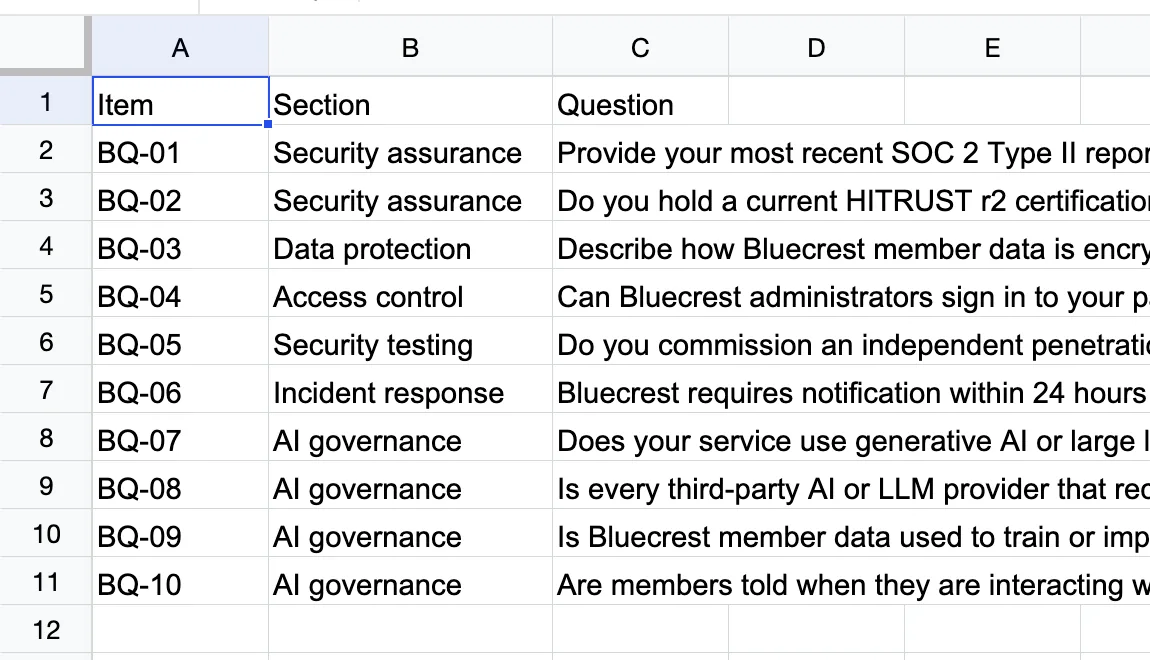
What a strong candidate did: Answered each item with what is true today, said plainly where a control is not yet in place, and kept every answer consistent with the contract.
A design on a whiteboard, then a written note
Fitting a partner’s SSO and reporting asks onto the platform
After a discovery call, a large partner wants single sign-on from its own portal and custom reporting. The candidate has the account executive’s raw notes and the platform’s integration guide.
What a strong candidate did: Separated what the platform already supports from real new work, drew how the sign-on would flow, and listed the questions to settle with the partner before any promise is made.
How the decision gets made
With Gateway, enterprise architect candidates work through situations from your job description, such as answering a governance and security review honestly and fitting a partner's sign-on and reporting needs onto the current estate. They work in a spreadsheet, a written response and a whiteboard design. The CIO or CTO sees a score and written feedback per skill and opens each response read-only, then keeps the final conversations for candidates who were clear about what is true today and what it will take to change it.
See your next enterprise architect at work before you meet them
Paste your job description and Gateway writes the assessment in about 5 to 10 minutes. Your team can edit every question before it goes out.
Questions
Can a short assessment tell us anything about an enterprise-level role?
It shows how the candidate reasons on a real problem modelled on your estate, in writing and in a design, which is what panels struggle to see. It does not replace the conversations with your leadership; it decides who is worth them.
Can our CFO or head of risk review the answers?
Yes. Results can be shared with a hiring manager with a note, and each written answer opens read-only, so a reviewer outside technology can read the governance response directly.
Would an async video round help for this role?
For senior hires, a continuous async video interview lets your panel record questions on video once. Candidates answer before a deadline, every answer is written out and scored, and each panel member votes and leaves notes.
Will candidates have seen the questions before?
Gateway writes the assessment from your job description, and there is no question bank circulating online. Your team can edit each question to match your estate before sending.
Who decides the outcome for an enterprise architect?
Your team. Gateway gives a tier from 1 to 5 and whether the candidate meets your line, and any score can be changed.
Related