Hire a requirements analyst who writes requirements you can test
A requirements analyst is worth hiring when every requirement on the project is clear enough that two engineers read it the same way, a tester can verify it, and anyone can trace it back to the need it came from. Most candidates claim elicitation and traceability, so the way to tell requirements analysts apart is to see each one turn an ambiguous request into testable requirements before the interviews.
What the hiring manager needs from a requirements analyst
Requirements analysts are often hired on projects where a misread requirement is expensive: regulated products, public-sector systems, contracts where the vendor builds exactly what is written. The engineering or programme lead needs a person who removes ambiguity before design starts and keeps the requirement set controlled as things change.
Words that mean different things to different readers
A requirement says the system must respond "quickly" and handle "all valid inputs". A strong requirements analyst replaces each vague word with a measurable condition, lists what counts as valid, and asks the customer to confirm the edge cases rather than guessing them.
A change request late in the project
The customer wants a rule changed after design is signed off. The requirements analyst uses the traceability matrix to show every design item and test case the change touches, so the change board decides with the real cost in front of it.
Non-functional requirements nobody wrote
Security, availability, audit logging and data retention are missing from the specification. The analyst raises them early, gets an owner for each, and writes them in a form the test team can check, instead of discovering them at acceptance.
Verification that does not match the requirement
Test cases pass but cover only the happy path. The requirements analyst reviews coverage against each requirement and flags the ones with no test or a test that cannot fail.
Where hiring a requirements analyst usually goes wrong
- Reading the standards list as proof
- Candidates name IEEE, ISO and modelling notations they have worked under. That shows familiarity with the paperwork, and tells you little about whether the candidate can spot that "the system shall be easy to use" cannot be verified.
- Rewarding long specifications
- More pages can mean more ambiguity. A good requirements analyst often produces fewer, sharper statements with acceptance criteria, which looks thinner in a portfolio and saves weeks in testing.
- Never asking for a written sample
- The whole output of the role is written requirements, yet many interviews are spoken. Without a written sample you cannot see whether each requirement is single, testable and traceable.
Real tasks from a Gateway assessment
These come from a Gateway assessment for a product manager, with the employer’s name taken out. Gateway writes every assessment from your own job description, so the tasks your candidates get are built around your role.
A flow on a whiteboard, then a written spec
Spec a change customers describe as “just make it work”
A payroll customer’s HR manager asks that the product “just do the right thing” when an employee moves to another state partway through a pay period.
What a strong candidate did: Turned the request into the exact cases that must work, said what the first release will not cover, and wrote acceptance criteria engineering could build and test against.
A spreadsheet, then three slides for leadership
Launch scope for an AI assistant
A pilot tested an AI assistant that answers employees’ questions about their pay stub. The ML engineer has exported the reviewed answers.
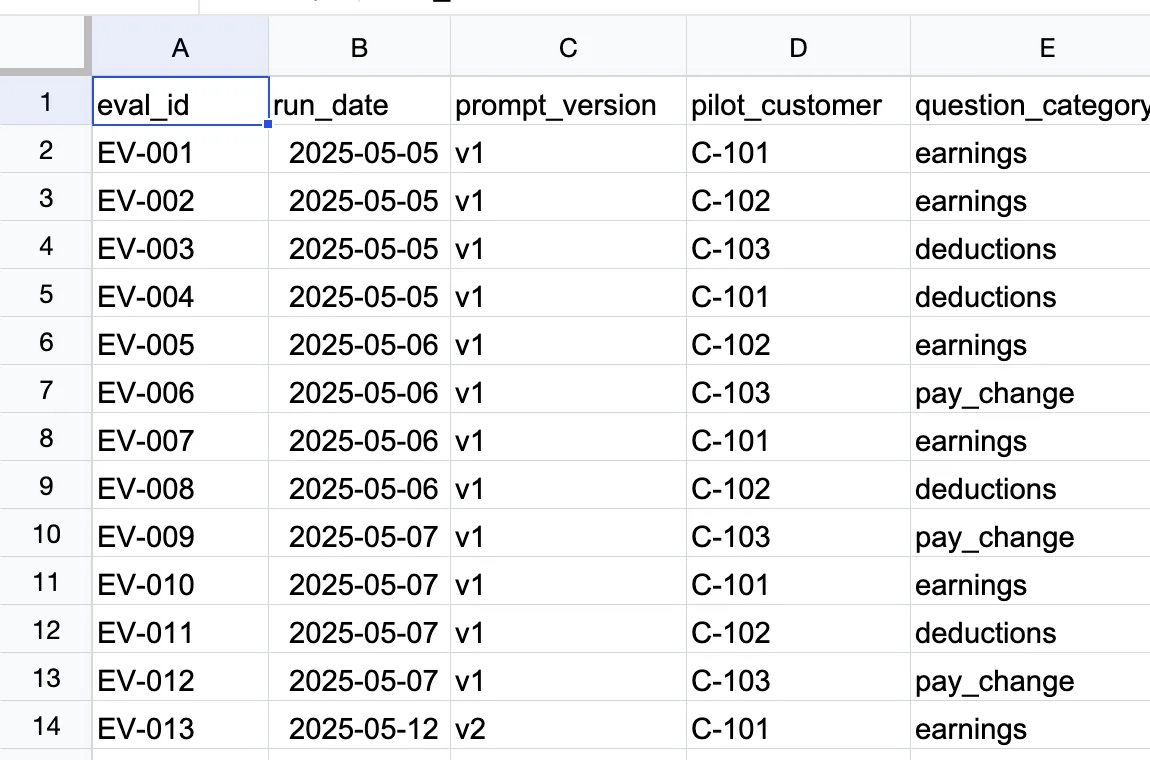
What a strong candidate did: Launched only the question types the pilot handled well, kept the risky ones with a person, and gave leadership one clear decision to make.
How the decision gets made
In Gateway, requirements analyst candidates take an ambiguous request from your domain, map the cases on a whiteboard, and write requirements with acceptance criteria in a document. A further task can ask the candidate to decide what is in and out of a release and justify it from pilot data in a spreadsheet. The hiring manager sees a score and written feedback for skills like precision, testability and scope control, opens every document read-only, and meets only the requirements analysts whose statements an engineer and a tester would read the same way.
See your next requirements analyst at work before you meet them
Paste your job description and Gateway writes the assessment in about 5 to 10 minutes. Your team can edit every question before it goes out.
Questions
Can the assessment reflect a regulated or contract-driven project?
Gateway writes the assessment from your job description, so if the role works under a regulated process or a fixed-scope contract, the situations carry that context. Your team edits every question before it is sent.
How is a requirements analyst assessed differently from a business analyst?
The focus your job description sets decides it. For requirements analysts the work centres on precise, testable statements, acceptance criteria, scope boundaries and traceability, and the per-skill scores reflect those.
Can our test lead check the requirements a candidate wrote?
Yes. Every document opens read-only in the tool the candidate used, and results can be shared with a hiring manager or test lead with a note. Your team can change any score and makes the decision.
What does the candidate need to take part?
A laptop or desktop and one link. Each step tells the candidate what it involves, such as a whiteboard flow or a written specification, before the candidate accepts it.
Related