Hire a sales manager whose forecast you can take to the board
A sales manager is worth the seat when the committed number is the number the team closes, and when each rep on the team sells better a quarter later. A strong personal quota record does not show either skill, so the way to separate candidates is to watch each one call a forecast from a messy CRM export and coach a rep through a lost call before any interview.
What the hiring manager needs from a sales manager
Whoever hires a sales manager is handing over a team and a revenue line. The founder or sales director needs someone who reads a pipeline honestly, tells leadership early when the quarter is at risk, and lifts the reps who are stuck in the middle of the table rather than closing their deals for them.
The forecast call in the second week
Leadership asks for the quarter's number before the new manager knows the reps well. The CRM shows deals at every stage, some of them sitting in commit because a rep wants them there. A good sales manager challenges each late-stage deal on evidence (a confirmed budget, a signer, a date) and gives a number with a range.
A rep who keeps losing at discovery
Demos are booked, then deals go quiet. Listening to one call shows the rep pitching in the third minute and never finding out what the buyer needed. The manager has to name the exact moments that lost the deal and give the rep questions to use on Monday.
Three deals that decide the quarter
Most quarters turn on a handful of accounts. The manager decides which ones get leadership time, which need a second contact on the buyer side, and which should be moved out of the quarter before they embarrass the forecast.
A pipeline review that changes behaviour
Weekly reviews can become status theatre where every rep says things are going well. A sales manager who runs them well asks for the next step, the date and the person who agreed to it, and the team starts keeping the CRM honest because of it.
Where hiring a sales manager usually goes wrong
- Promoting the top closer
- The rep who beat quota every quarter is often a poor manager of reps who do not sell the same way. Personal numbers on a resume say nothing about whether the candidate can raise a struggling rep's conversion or will simply take over the big deals.
- Interviews that reward a confident story
- Sales leaders interview well by profession. A panel that asks about past targets hears polished numbers that nobody can check, and learns little about how the candidate treats a deal that a rep insists is closing this month.
- No look at forecasting judgement
- Most sales manager interviews never put a pipeline in front of the candidate. The first time the hiring team sees how the person forecasts is the first missed quarter, which is the most expensive time to find out.
- Coaching taken on trust
- Every candidate says coaching is a strength. Without hearing the candidate coach a real call, there is no way to tell specific, usable feedback from general encouragement that changes nothing on the next call.
Real tasks from a Gateway assessment
These come from a Gateway assessment for a sales manager, with the employer’s name taken out. Gateway writes every assessment from your own job description, so the tasks your candidates get are built around your role.
A spreadsheet, then a short forecast note
Calling the quarter: a forecast from a CRM export
In their second week, a new enterprise sales manager is asked for the quarter’s forecast. The CRM export has deals at every stage, and some are more hopeful than real.
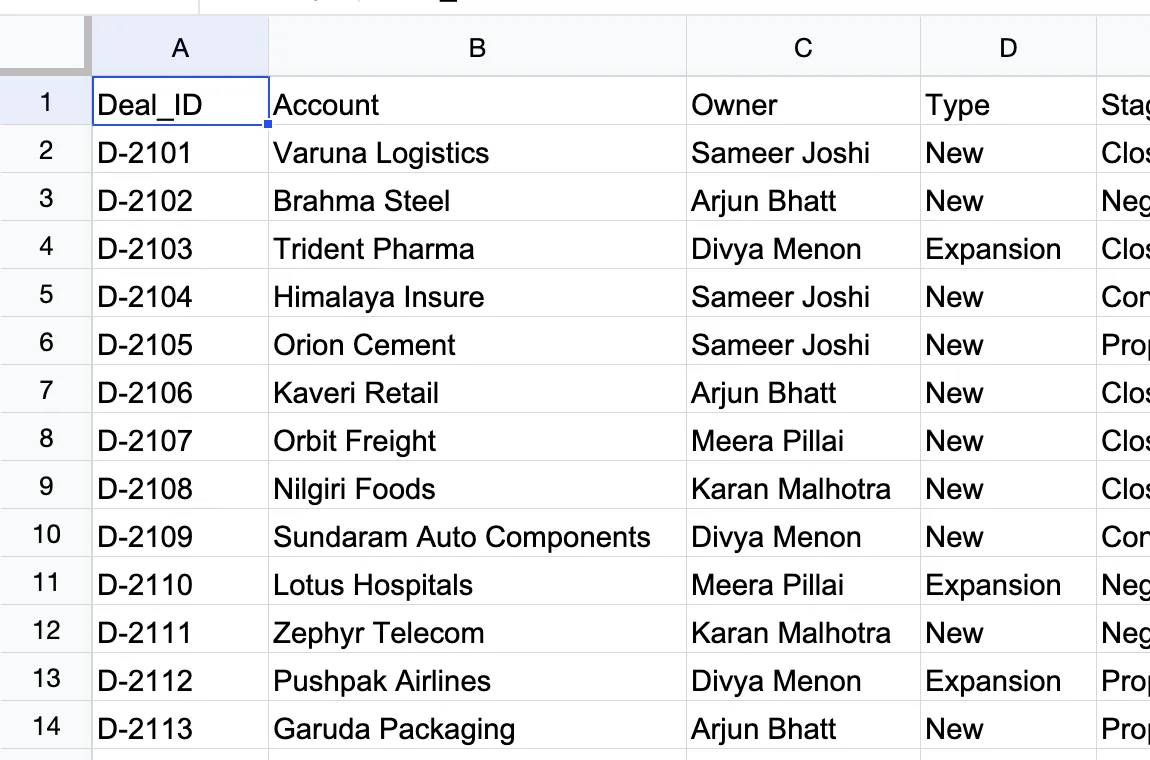
What a strong candidate did: Called a number with a range, showed which deals were inflated and why, and named the three deals that decide the quarter and what each needs this week.
A written coaching plan and a live coaching conversation
Coach an account executive on a weak discovery call
The sales director shares a recording of a discovery call that went badly and asks the candidate to coach the account executive who ran it.
What a strong candidate did: Named the two moments where the call was lost, gave the executive specific questions to use instead, and agreed on how to check the change on the next calls.
A live conversation with an AI buyer
First meeting with a buyer on a live call
A treasurer at a 220-flat housing society has agreed to a short first conversation about gate and visitor management before her accounts meeting. An AI plays her.
What a strong candidate did: Asked about the society’s real problems before pitching, handled the price concern with facts, and left with a clear next step and who else needs to be in it.
How the decision gets made
With Gateway, each sales manager candidate works through situations written from your job description: calling the quarter from a CRM export in a spreadsheet with a short forecast note, writing a coaching plan for a weak discovery call, and a live conversation with an AI buyer who pushes back as a real buyer would. The sales director sees a score and written feedback for each skill, opens the spreadsheet and the plan read-only, and spends the final interviews only on candidates whose forecast held up and whose coaching was specific. If the funnel is large, a voice interview of up to 15 minutes can come first to cover team size, quota history and how the candidate runs a review.
See your next sales manager at work before you meet them
Paste your job description and Gateway writes the assessment in about 5 to 10 minutes. Your team can edit every question before it goes out.
Questions
Can the forecast task use our sales cycle and deal sizes?
Gateway writes the assessment from your job description in about 5 to 10 minutes, so the CRM export, stages and buyer types follow the role you described. Your team can edit any deal or question before sending it.
How do we see whether a candidate can coach, and not just sell?
One task gives the candidate a weak discovery call and asks for a coaching plan, then a live coaching conversation. You read exactly what the candidate told the rep to change, scored with the reason.
Can an AI interviewer screen sales manager applicants first?
Yes. The voice interview runs up to 15 minutes in the browser or as a call to an Indian number, says it is an AI at the start, follows up on vague answers, and scores each topic on what was said, never on voice or accent.
Who makes the final call?
Your team. Each candidate gets a tier from 1 to 5 and a mark against your line, and any score can be changed. The sales director decides who reaches the final round.
Does the candidate need special software?
A laptop or desktop and one link. Each step tells the candidate what it involves before it starts, and the spreadsheet and documents open in the browser.
Related