Hire a business analyst who finds the real need behind the request
A business analyst is worth the hire when a project builds what the business actually needed the first time, because the analyst asked the right people the right questions and wrote it down so that developers and testers agree on it. Resumes full of BRDs and stakeholder workshops all read alike, so the way to tell business analysts apart is to give each one a real, messy request and some data before the first interview.
What the hiring manager needs from a business analyst
Business analysts are usually hired by a project or change lead who has business users on one side, an IT team or vendor on the other, and a history of requirements that were misunderstood. The analyst has to understand how the work is done today, what must change, and write that up so both sides sign the same thing.
Stakeholders who describe a solution instead of a problem
Operations asks for a new screen to approve refunds. A good business analyst asks why refunds need approval, finds that the real issue is fraud on a few account types, and comes back with requirements that solve that, which may not be a new screen at all.
Mapping how the work really happens today
The documented process says three steps, but staff use a shared spreadsheet and two email workarounds. The business analyst sits with the people doing the work, maps the as-is flow honestly, and shows where the proposed system would break their day.
Conflicting requirements from two departments
Finance wants every order held until credit is checked; sales wants orders released at once. The analyst puts both rules side by side with their cost, takes the conflict to the sponsor with a recommendation, and records the decision so it is not reopened in testing.
User acceptance testing that keeps failing
Business users reject builds that match the written requirement. The business analyst traces each failure to a missing case or an assumption nobody wrote down, fixes the requirement, and helps users write test cases that reflect real transactions.
Where hiring a business analyst usually goes wrong
- Counting documents instead of reading one
- Candidates list BRDs, FRDs, use cases and process maps. Few loops ask to see something the candidate wrote, so a business analyst who produces long, vague documents gets hired on the length of the list.
- Testing tool knowledge over judgement
- Jira, Confluence, Visio and BPMN notation are easy to learn. The expensive gap is an analyst who writes down exactly what a loud stakeholder said and never asks why, which only shows up when the analyst works through a real request.
- Hiring on domain alone
- Years in banking or insurance help, but domain knowledge without analysis means the candidate repeats how things were done at the last employer. Watch whether the candidate questions the request in front of them.
- Skipping the data
- Many business analyst roles need someone to pull numbers from a spreadsheet to size a problem or back a recommendation. Interviews built only on conversation miss candidates who freeze when asked to support a claim with data.
Real tasks from a Gateway assessment
These come from a Gateway assessment for a product manager, with the employer’s name taken out. Gateway writes every assessment from your own job description, so the tasks your candidates get are built around your role.
A spreadsheet of funnel data, then a written decision
Find the friction in onboarding and pick the next fix
Customers say contractors “get stuck” in a five-step onboarding. Next sprint can take one fix.
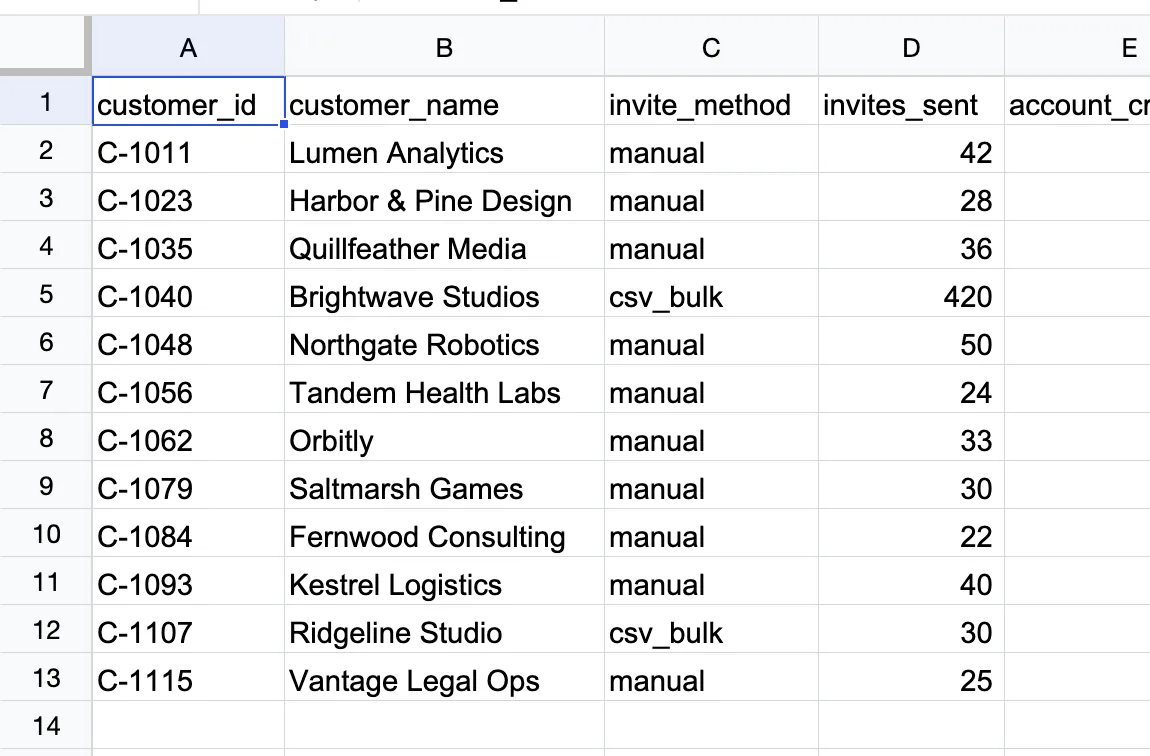
What a strong candidate did: Found the step where most contractors stop and why, picked one fix with the expected gain, and said how to know within two weeks whether it worked.
A flow on a whiteboard, then a written spec
Spec a change customers describe as “just make it work”
A payroll customer’s HR manager asks that the product “just do the right thing” when an employee moves to another state partway through a pay period.
What a strong candidate did: Turned the request into the exact cases that must work, said what the first release will not cover, and wrote acceptance criteria engineering could build and test against.
How the decision gets made
In Gateway, business analyst candidates work through situations drawn from your job description: a spreadsheet of process or funnel data where they have to find the real problem, then a request that has to be mapped on a whiteboard and written up as requirements with acceptance criteria. Where the role faces business users directly, a chat with an AI stakeholder who pushes back the way a real department head would shows how the candidate questions a request. The hiring manager gets a score and written feedback for each skill, can open every spreadsheet, flow and document read-only, and meets only the business analysts whose requirements would survive a real project.
See your next business analyst at work before you meet them
Paste your job description and Gateway writes the assessment in about 5 to 10 minutes. Your team can edit every question before it goes out.
Questions
Can the assessment match our industry, such as banking or retail?
Yes. Gateway builds each assessment from your job description, so the processes, data and stakeholders come from your domain. Your team can read and change every question before candidates see it.
Can we see how a candidate questions stakeholders?
A chat or call with an AI stakeholder who pushes back can be part of the assessment. You read the full exchange and see whether the business analyst asked about the underlying problem or simply wrote down the first request.
We hire business analysts for several projects at once. Does that work?
Add candidates from an ATS export, a spreadsheet or resumes. Each one gets a single link and a deadline, and results show who meets the line you set for each skill.
Is there any multiple choice on BA techniques?
No. Gateway has no multiple choice and no question bank that circulates online. Candidates produce real work, such as a process flow or a requirements document, and that work is what gets scored.
Can the project sponsor see the results?
Results can be shared with a hiring manager with a note, and every piece of work opens read-only, so a sponsor can read the requirements a candidate wrote before agreeing to an interview.
Related