Hire a systems analyst who knows what a change breaks downstream
A systems analyst is worth hiring when a change to one application reaches production without breaking the interfaces, reports and batch jobs that depend on it. Resumes list the same SDLC phases and the same ERP names, so the way to tell systems analysts apart is to give each one a real change and a picture of your systems, and see what the candidate traces before any interview.
What the hiring manager needs from a systems analyst
An IT manager or application lead hiring a systems analyst usually runs a landscape of systems that were never designed together: an ERP, a CRM, a data warehouse, a few in-house tools and nightly file transfers between them. The systems analyst has to turn a business change into a specification developers can build, while knowing exactly which other systems the change touches.
A new field that has to travel through every connected system
The business adds a customer category in the CRM. A good systems analyst maps where that field must flow, into billing, the warehouse and the nightly feed to the reporting team, writes the field mappings and default values, and flags the report that will break if nobody updates it.
An interface failing in production
Orders stop reaching the warehouse system and the error log says little. The systems analyst reads the interface specification, queries both databases with SQL, finds the record format the upstream change broke, and gives developers a precise description of the fix.
A vendor package that does not quite fit
The company bought software that covers most of the process. The systems analyst works out which gaps can be handled through configuration, which need a custom extension, and which the business should change its process to avoid, and documents each choice.
Impact analysis before a legacy change
Someone wants to retire an old table. The systems analyst finds every job, view and interface that reads it, including the ones nobody documented, before the change request is approved.
Where hiring a systems analyst usually goes wrong
- Hiring a business analyst for a technical seat
- Many candidates with the title write good user requirements and stop at the application boundary. If your systems analyst must read schemas, interface specs and logs, test for that work, or the developers end up doing the analysis.
- Hiring a developer who documents nothing
- The opposite mistake is a strong coder who changes the integration directly and leaves no specification. The next change then starts from guesswork about what the last one did.
- Assuming ERP experience transfers
- Years on one ERP product do not mean the candidate can analyse a landscape built differently. What matters is whether the person can trace data through systems the person has never seen, given diagrams and access.
Real tasks from a Gateway assessment
These come from a Gateway assessment for a product manager, with the employer’s name taken out. Gateway writes every assessment from your own job description, so the tasks your candidates get are built around your role.
A spreadsheet, then three slides for leadership
Launch scope for an AI assistant
A pilot tested an AI assistant that answers employees’ questions about their pay stub. The ML engineer has exported the reviewed answers.
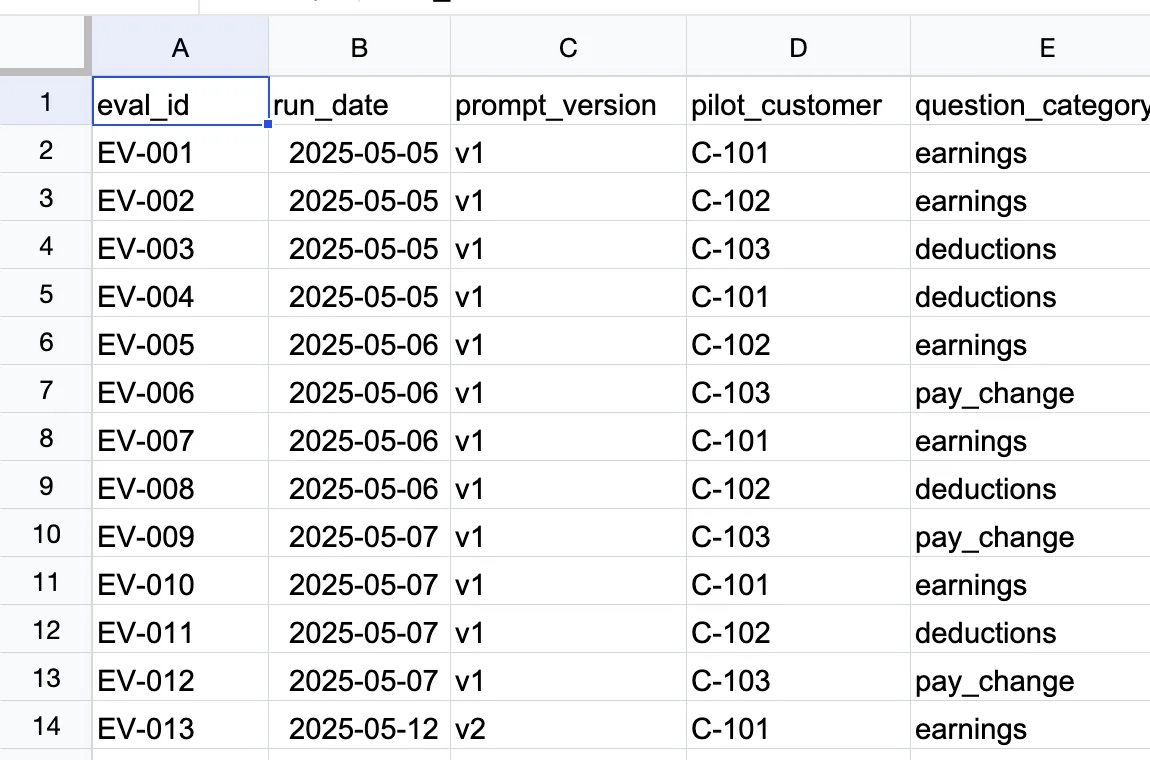
What a strong candidate did: Launched only the question types the pilot handled well, kept the risky ones with a person, and gave leadership one clear decision to make.
A flow on a whiteboard, then a written spec
Spec a change customers describe as “just make it work”
A payroll customer’s HR manager asks that the product “just do the right thing” when an employee moves to another state partway through a pay period.
What a strong candidate did: Turned the request into the exact cases that must work, said what the first release will not cover, and wrote acceptance criteria engineering could build and test against.
How the decision gets made
In Gateway, systems analyst candidates get situations written from your job description: a change to trace across a set of connected systems on a whiteboard, data to query in SQL to find where records go wrong, and a written specification or field mapping developers could build from. A recorded walkthrough can show how the candidate explains the impact of a change to a non-technical owner. The hiring manager sees a score and written feedback for each skill, opens every diagram, query and specification read-only, and only meets the systems analysts who found the downstream effects a careless analysis would miss.
See your next systems analyst at work before you meet them
Paste your job description and Gateway writes the assessment in about 5 to 10 minutes. Your team can edit every question before it goes out.
Questions
Can candidates write SQL in the assessment?
Yes. Gateway includes a SQL environment, along with a whiteboard, documents and spreadsheets, so a systems analyst can query the data and then write up the specification in the same assessment.
Can the scenario use systems like ours?
The assessment is written from your job description, so if the role works across an ERP, a CRM and a data warehouse, the situations describe that kind of landscape. Your team can add detail or edit any question before it goes out.
How do we see how the candidate traced the impact?
Each candidate's whiteboard, queries and documents open read-only in the same tools they were made in, next to a score and written feedback for each skill. Your team can change any score.
Can a candidate look up documentation or use AI during the test?
You decide. An AI-assisted assessment allows an AI assistant and shows your team how the candidate used it. Monitoring is off by default, and if you turn it on, Gateway never marks anyone as cheating by itself: your team reviews anything unusual.
Related