Hire a cloud architect whose designs survive contact with the business
A cloud architect is worth the seat when designs hold up against cost, security reviews and the teams who have to build them, and when the trade-offs are written down where leadership can read them. Senior resumes all list migrations and certifications, so the clear way to tell candidates apart is to see each one design and defend a real decision before your leadership spends time on interviews.
What the hiring manager needs from a cloud architect
The CTO or VP of engineering hiring a cloud architect wants fewer expensive surprises: a migration that stalls halfway, a client security questionnaire that nobody can answer honestly, a design that only its author understands. The person in this seat sets direction that other engineers build on for years.
A landing zone before the second product line
A new product line needs its own environments, data boundaries and billing. The architect decides how accounts or subscriptions, networks and identity are laid out so the next product does not reopen the same argument.
A client's security and compliance review
An enterprise prospect sends a questionnaire about encryption, data residency and access controls. The architect answers what is true today, names the gaps plainly, and gives sales an answer that will still be true after the contract is signed.
Resilience the business can afford
Leadership asks for multi-region after an outage. The architect sets out what a second region costs in money and complexity, what recovery time the business actually needs, and a cheaper design that meets it if one exists.
Integrating a partner into the platform
A large partner wants single sign-on from its own portal and data feeds back into its systems. The architect separates what the platform supports today from new work and lists what must be agreed before anyone commits to a date.
Where hiring a cloud architect usually goes wrong
- Judging by the polish of the diagrams
- A clean architecture diagram can hide the fact that nobody thought about identity, cost or how the design will be operated. What matters is whether each box has a reason and each trade-off is stated.
- Running the generic system design round
- Designing a URL shortener on a whiteboard tests a pattern most senior candidates have rehearsed. Your architect will face your constraints: an existing estate, a compliance promise, a budget and teams with their own opinions.
- Hiring someone who has stopped building
- Some architects have only drawn for years. When the design meets a Terraform module or a pipeline, they cannot say whether it is workable, and the engineers stop trusting the designs.
- Equating professional certifications with judgement
- Professional level cloud certifications show breadth. They do not show whether the candidate will tell a sales director that a requested feature is not secure enough to promise.
Real tasks from a Gateway assessment
These come from a Gateway assessment for a solutions architect, with the employer’s name taken out. Gateway writes every assessment from your own job description, so the tasks your candidates get are built around your role.
A design on a whiteboard, then a written note
Fitting a partner’s SSO and reporting asks onto the platform
After a discovery call, a large partner wants single sign-on from its own portal and custom reporting. The candidate has the account executive’s raw notes and the platform’s integration guide.
What a strong candidate did: Separated what the platform already supports from real new work, drew how the sign-on would flow, and listed the questions to settle with the partner before any promise is made.
A spreadsheet and a written response
Answering a client’s AI and security review
Before contracting, a health plan’s security and AI governance analyst sends a ten-item questionnaire with a deadline. The candidate owns the response.
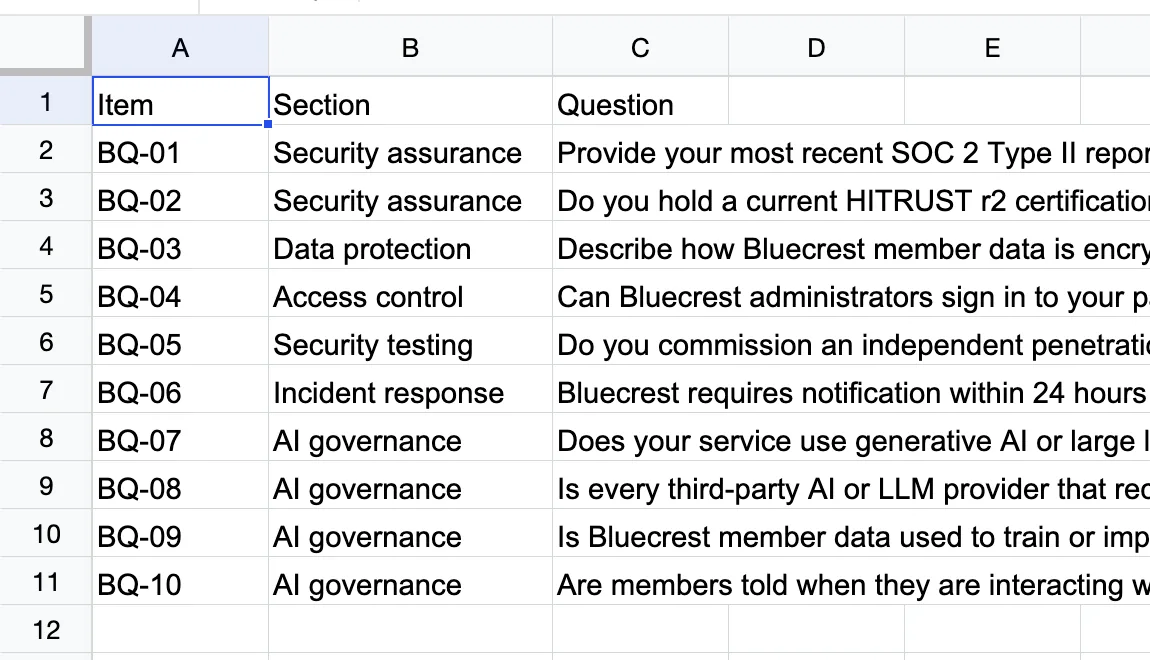
What a strong candidate did: Answered each item with what is true today, said plainly where a control is not yet in place, and kept every answer consistent with the contract.
How the decision gets made
For a cloud architect, Gateway sets situations from your job description that call for design on a whiteboard and a written note, such as fitting a partner's sign-on onto the platform or answering a client's security review honestly. Leadership reads per skill scores with the reasoning and opens each design read-only. For a senior hire, many teams add an async video interview in continuous mode, so the CTO and panel record their questions once, review answers that are written out and scored, vote, and leave the final call to the hiring manager.
See your next cloud architect at work before you meet them
Paste your job description and Gateway writes the assessment in about 5 to 10 minutes. Your team can edit every question before it goes out.
Questions
Is a work assessment appropriate for a senior architect?
Yes, when the task is the real work. Candidates design, write and defend decisions on situations from your role, which is a better use of senior time than a puzzle round. Every step says what it involves before the candidate accepts it.
Can the panel compare designs from different candidates?
Yes. Each design opens read-only in the same whiteboard or document the candidate used, with a score and written feedback for each skill beside it, so panel members can compare reasoning rather than presentation.
Can we combine the assessment with a video interview round?
Yes. Async video interviews let your CTO and panel record questions once. Candidates answer before a deadline, every answer is transcribed and scored with suggested follow-ups, and panel members vote and add notes.
Can we edit the tasks to match our cloud and compliance setup?
Yes. Gateway writes the assessment from your job description in about 5 to 10 minutes, and your team can change any question, constraint or detail before it goes out.
Related