Hire a C++ developer who fixes the race instead of hiding it
A C++ developer earns a place by writing code where ownership is clear, threads cannot corrupt shared data and latency stays within budget, in codebases that often run for years on real hardware. C++ interviews tend to test language trivia, so the dependable way to compare candidates is to see each one fix and design real systems code before your team interviews.
What the hiring manager needs from a C++ developer
Employers hiring a C++ developer usually run software where performance or reliability is the point: flight and defence systems, trading, robotics, games, simulation, or desktop applications with heavy computation. The engineering lead needs someone who works comfortably in modern C++ and in the older parts of the codebase that predate it.
A freeze that nobody can reproduce
A producer thread fills a queue and a consumer thread sends data on, and once in a while everything stops. A capable C++ developer finds the race or the missed notification, fixes it without adding latency, and writes a stress test that fails on the old code.
Raw pointers with unclear owners
An older module passes raw pointers between components, and a crash appears after an object is deleted while another part still reads it. The developer has to decide who owns each object, move to RAII and smart pointers where it helps, and keep hot paths free of extra allocations.
Templates that the next engineer cannot change
Several kinds of record share a container through templates and specialisations. The developer needs to keep type-specific behaviour where it belongs and leave code a reviewer can follow, without template tricks that make compile errors unreadable.
Undefined behaviour that only shows in release builds
A function works in debug and returns garbage with optimisation on. Knowing how to use sanitizers, compiler warnings and careful reading to find uninitialised memory or out-of-bounds access is everyday C++ work.
Where hiring a C++ developer usually goes wrong
- Quizzing on obscure language rules
- Questions about the rule of five, virtual inheritance or template corner cases reward recall. A candidate can answer them well and still write a data race on the first day.
- Treating C with classes as modern C++
- Resumes often say C++ when the work was mostly C-style code with manual memory management. Only reading the candidate's code shows whether the person uses RAII, value semantics and the standard library well.
- Ignoring concurrency until after the hire
- Many C++ systems are heavily multi-threaded. Hiring loops that test single-threaded algorithms miss the skill that most often causes field failures.
- Not checking how the change is explained
- In safety-critical or performance-critical teams, every change goes through careful review. A developer who cannot write a clear note on what changed and why slows every reviewer down.
Real tasks from a Gateway assessment
These come from a Gateway assessment for a C++ developer, with the employer’s name taken out. Gateway writes every assessment from your own job description, so the tasks your candidates get are built around your role.
C++, then a short note
Telemetry queue: fix the race and prove it
On an unmanned aircraft, a sensor thread fills a bounded queue and a link thread sends frames over the radio. Telemetry freezes now and then in the field, and nobody can reproduce it on demand.
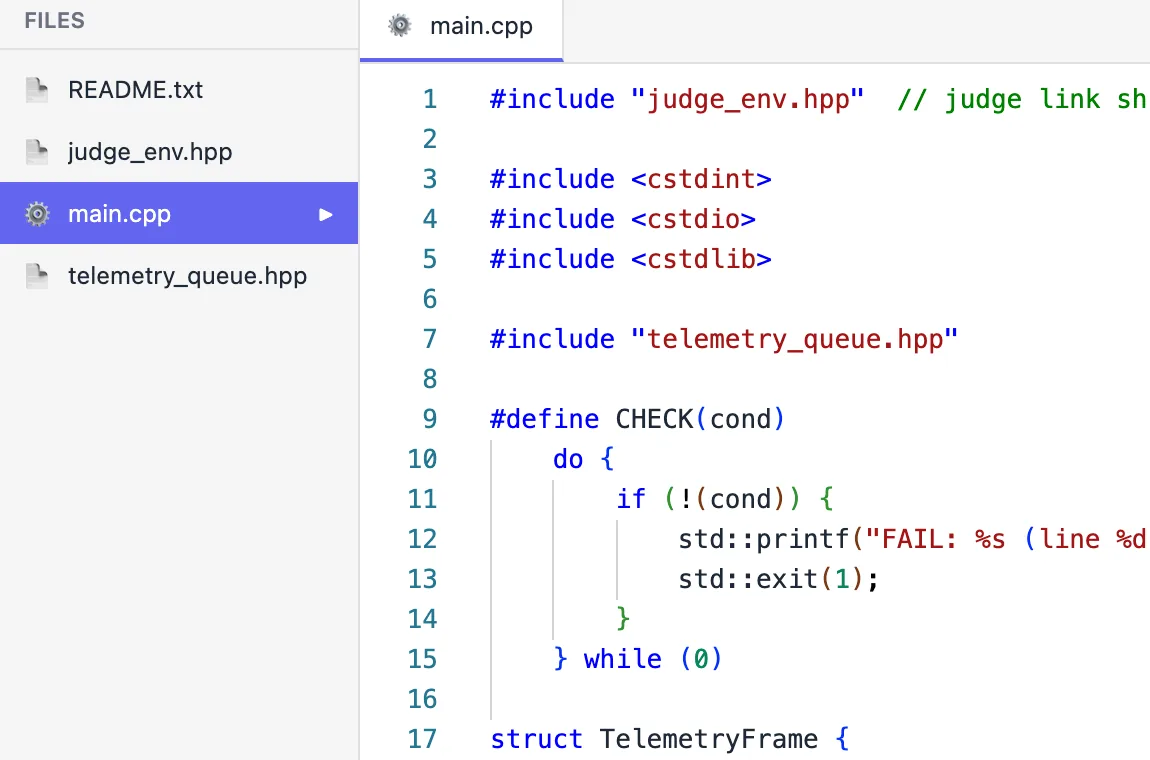
What a strong candidate did: Found the race in the queue, fixed it without adding latency, and wrote a stress test that fails reliably on the old code and passes on the new.
C++, then a short note
Radar track store: ownership and templates
The flight software lead asks for the in-memory list of radar tracks that the display and cueing logic read. Three kinds of track rank themselves differently, and the lead will review the change.
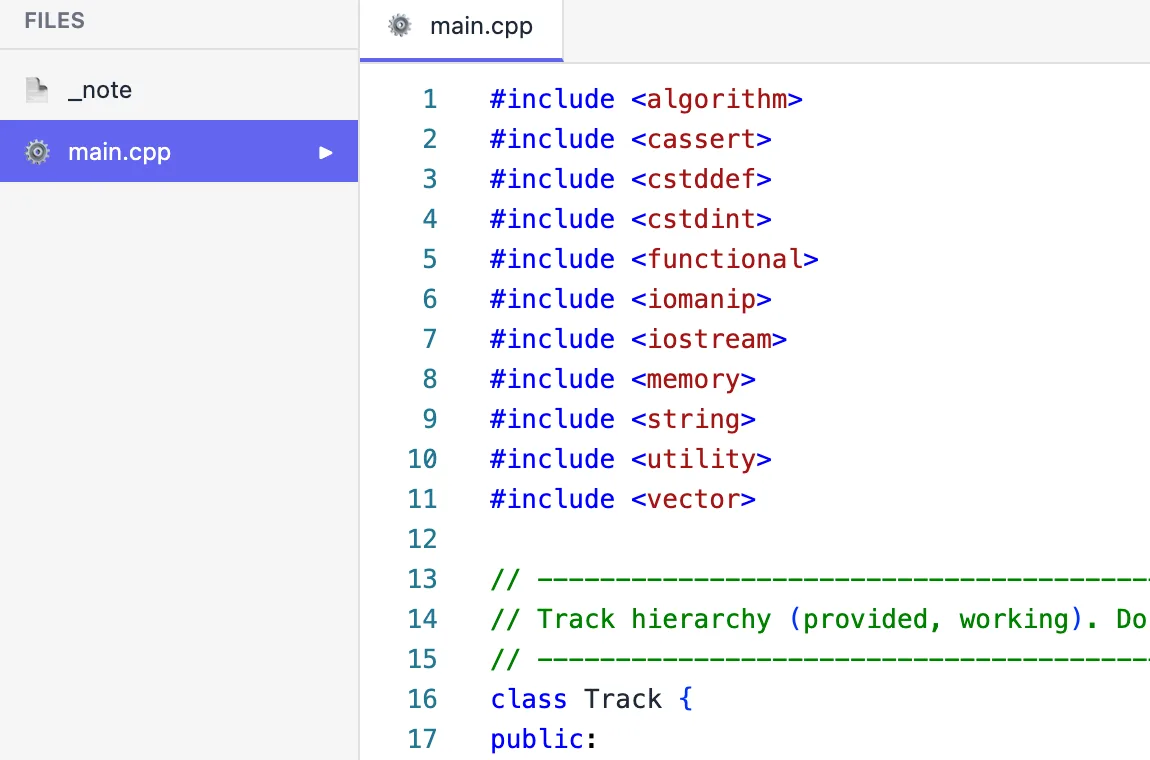
What a strong candidate did: Gave the store clear ownership of its tracks, kept ranking inside each track type, and made the reads safe for the display while tracks are added.
How the decision gets made
With Gateway, each C++ candidate works on situations from your job description, such as finding the race in a telemetry queue between a sensor thread and a radio link and proving the fix with a stress test, or building a track store with clear ownership and safe reads for a display. Candidates write C++ and a short note for the lead who will review it. The engineering lead sees each skill scored with written feedback, opens the code read-only, and invites only those whose fixes held up under test.
See your next C++ developer at work before you meet them
Paste your job description and Gateway writes the assessment in about 5 to 10 minutes. Your team can edit every question before it goes out.
Questions
Can the assessment use our C++ standard and build constraints?
Yes. Put the standard, libraries and constraints in your job description, or edit the tasks directly. Your team reviews every question before it goes out.
Do candidates compile and run their code?
Candidates work in a real code editor, and the submitted code opens read-only for your engineers next to a score and written feedback for each skill.
Our work involves hardware decisions too. Can that be tested?
Yes. One assessment can combine code with a spreadsheet and a written recommendation, for example choosing parts against a power budget and listing what the drivers must handle.
How long does preparing a C++ assessment take?
Gateway drafts it from your job description in about 5 to 10 minutes. Your team then reads and edits it before sending each candidate one link and a deadline.
Related