Hire a Node.js developer who keeps the event loop free and the service up
A Node.js developer runs server code on a single-threaded runtime where one slow function, one unhandled promise or one leaking cache affects every request at once. Most candidates know the syntax, so the way to tell them apart is to see each one fix a real service problem in Node before your team spends time on interviews.
What the hiring manager needs from a Node.js developer
When a team asks specifically for a Node.js developer, it usually runs APIs, workers or real-time features on Node, often with NestJS, Fastify or Express, plus a large npm dependency tree. The backend lead needs someone who understands the runtime underneath the framework, because the failures that page people at night come from there.
An API that stalls whenever one report runs
Every request slows down while a large export is generated, because synchronous work is blocking the event loop. A good Node.js developer measures the blocking, moves the heavy work to a worker thread, a queue or a stream, and shows the latency recovered.
Memory that climbs until the container restarts
The service restarts every few hours with an out-of-memory error. The developer takes heap snapshots, finds the cache or listener that never releases, and fixes it instead of raising the memory limit.
An async error that takes the process down
A rejected promise somewhere in a callback path is never caught, and the whole process exits under load. The developer traces the path, handles the error where it belongs and makes sure the next one is logged with enough context to act on.
A dependency with a security advisory
An audit flags a package deep in node_modules that nobody chose directly. The developer works out whether the vulnerable code path is reachable, upgrades or pins safely, and checks the lockfile change does not drag in something else.
Where hiring a Node.js developer usually goes wrong
- Treating frontend JavaScript as Node experience
- Knowing JavaScript well in the browser does not mean knowing how Node schedules I/O, manages memory or behaves under concurrent load. The resume says JavaScript either way.
- Framework fluency without runtime understanding
- A candidate can build NestJS modules quickly and still put a CPU-heavy loop inside a request handler. Interviews that stay at the framework level never reach the event loop, which is where Node services fail.
- Async trivia instead of async debugging
- Asking for the output order of a setTimeout and a promise tests a puzzle. Watching a candidate find why a real request hangs tests the job.
- Not asking about production at all
- Many Node portfolios are side projects that never saw real traffic. Without seeing how a candidate approaches a leak or a crash, the team learns it in the first incident after the hire.
Real tasks from a Gateway assessment
These come from a Gateway assessment for a backend engineer, with the employer’s name taken out. Gateway writes every assessment from your own job description, so the tasks your candidates get are built around your role.
SQL, then a written note
Stale answers from the support assistant’s knowledge base
An AI support assistant answers from help articles that a nightly job splits, embeds and stores. Customers are getting answers from articles that were changed or removed weeks ago.
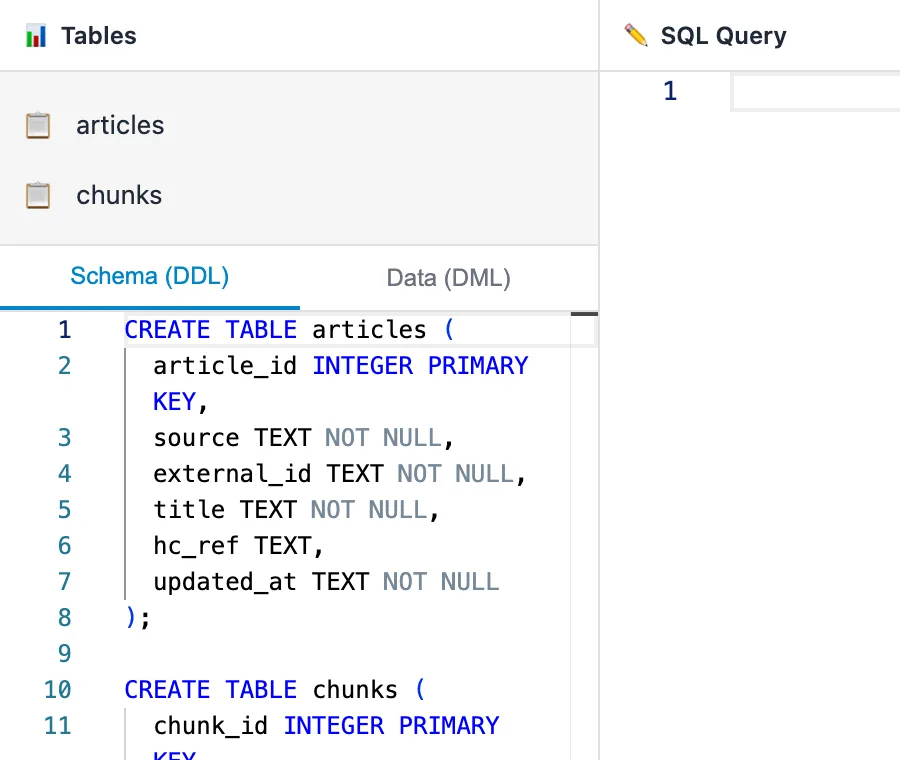
What a strong candidate did: Found in the data which articles were stale and why the refresh skipped them, sized how many answers were affected, and proposed a refresh that removes deleted articles as well as adding new ones.
A design on a whiteboard, then a written note
Nightly job ingestion from a partner scheduling API
Each night the product pulls changed jobs from a partner scheduling platform into PostgreSQL. At 06:00 a dispatch agent builds every business’s day plan from them, and dispatch teams start at 06:30. Jobs have been missing and duplicated.
What a strong candidate did: Designed an ingest that resumes from where it stopped, updates rather than duplicates, and finishes well before 06:00 with an alert if it will not. Named the one case that still needs a person to look.
How the decision gets made
With Gateway, Node.js developer candidates work through situations written from your job description: tracing stale data with SQL, designing a resumable nightly ingest, or fixing a webhook handler, all in the Node stack your role names. Candidates write code, design on a whiteboard and explain the change in a short note. The backend lead reads a score and written feedback for every skill, opens the code read-only, and interviews only candidates who already showed they understand what the runtime is doing.
See your next Node.js developer at work before you meet them
Paste your job description and Gateway writes the assessment in about 5 to 10 minutes. Your team can edit every question before it goes out.
Questions
Can the assessment use our framework, such as NestJS or Fastify?
Yes. Gateway writes the tasks from your job description, so they use the frameworks and libraries the role mentions. Your team can edit every question before it goes out.
Do candidates write TypeScript or JavaScript?
Whichever your job description asks for. If your services are in TypeScript, say so and the tasks follow.
How long does it take to set up?
About 5 to 10 minutes from a job description. Review the tasks, adjust anything, and send each candidate one link and a deadline.
Can candidates use Copilot or another assistant?
If you choose an AI-assisted assessment, yes, and your team sees how the candidate worked with it. A standard assessment keeps the work to the candidate.
What does our backend lead see?
A score and written feedback for each skill, a tier from 1 to 5, whether the candidate meets your line, and the candidate's code read-only. Your team can change any score and decides.
Related