Hire an AI engineer who ships LLM features you can trust with customers
An AI engineer builds product features on top of large language models: retrieval that only uses the right sources, prompt changes that are measured before release, and agents that cannot take a costly action on their own. Weekend demos are easy to produce, so the clearest signal is how a candidate builds a guardrail or reads an evaluation on a real situation, before your team spends time in interviews.
What the hiring manager needs from an AI engineer
The product or engineering lead hiring an AI engineer usually has an assistant, a copilot or an agent that customers or staff already use, and a list of ways it has embarrassed the company. The lead needs someone who treats the model as an unreliable component and builds retrieval, evaluation and approval steps around it.
An assistant quoting a policy that changed last month
Retrieval-augmented answers are only as current as the index. A strong AI engineer checks which documents the assistant may draw on, removes withdrawn or unapproved text from retrieval, and tests with questions where the old answer and the new one differ.
A prompt rewrite that looks better in the demo
The new prompt handles the five examples everyone tried. The AI engineer runs it against the evaluation set, looks at the cases where a mistake costs money or trust, and holds the release when it fixes the easy cases and breaks a rare expensive one.
An agent with access to tools that cannot be undone
Once an agent can send emails, post invoices or release payments, a hallucinated argument becomes a real action. The engineer separates low-risk actions from irreversible ones and requires a recorded human approval for the second kind.
Questions the assistant should not answer at all
Medical, legal or account-security questions need a handoff, not a fluent reply. The AI engineer writes the routing that recognises them, and tests it with phrasings real users would type rather than with the obvious keyword.
Where hiring an AI engineer usually goes wrong
- Hiring on a chatbot demo
- A polished demo built over a weekend shows that the candidate can call an API and design a chat window. It shows nothing about what happens on the inputs the demo never tried, which is where production incidents come from.
- Treating prompt writing as the core skill
- Clever prompts age with every model update. The durable skill is measurement: building an evaluation set, comparing versions on the cases that matter, and refusing to ship on impressions.
- Deep learning theory rounds for an application role
- Asking an AI engineer to derive attention or backpropagation tests a researcher's knowledge. Most of this role is composing models, retrieval and tools safely, and the theory round filters for the wrong person.
- Never asking about failure
- Interviews often cover what the candidate built and skip what the system does when the model is wrong, slow or confidently invented. That gap is where a weak hire leaves the lead cleaning up after customers.
Real tasks from a Gateway assessment
These come from a Gateway assessment for an AI engineer, with the employer’s name taken out. Gateway writes every assessment from your own job description, so the tasks your candidates get are built around your role.
Code, then a written note
Retrieval filter and safety gate for a health assistant
A patient-facing assistant answers questions about diabetes care from approved guideline text. It must never answer from text it should not use, and must hand off questions it should not answer.
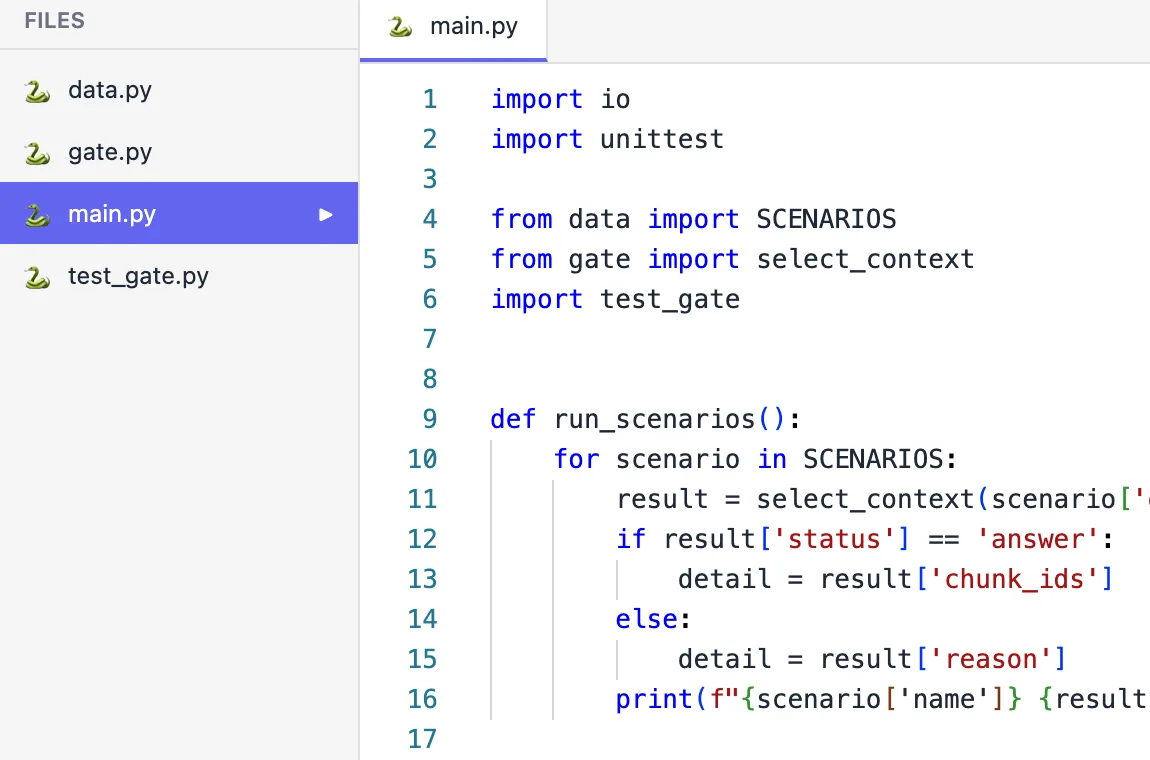
What a strong candidate did: Filtered retrieval to approved, current sources only, added a gate that routes medication and emergency questions to a clinician, and tested both with real-looking questions.
Code, then a short note
Release gate for irreversible payments
A payment agent proposes three kinds of action in SAP, including releasing wires that cannot be recalled once a bank accepts them. Treasury carries any loss.
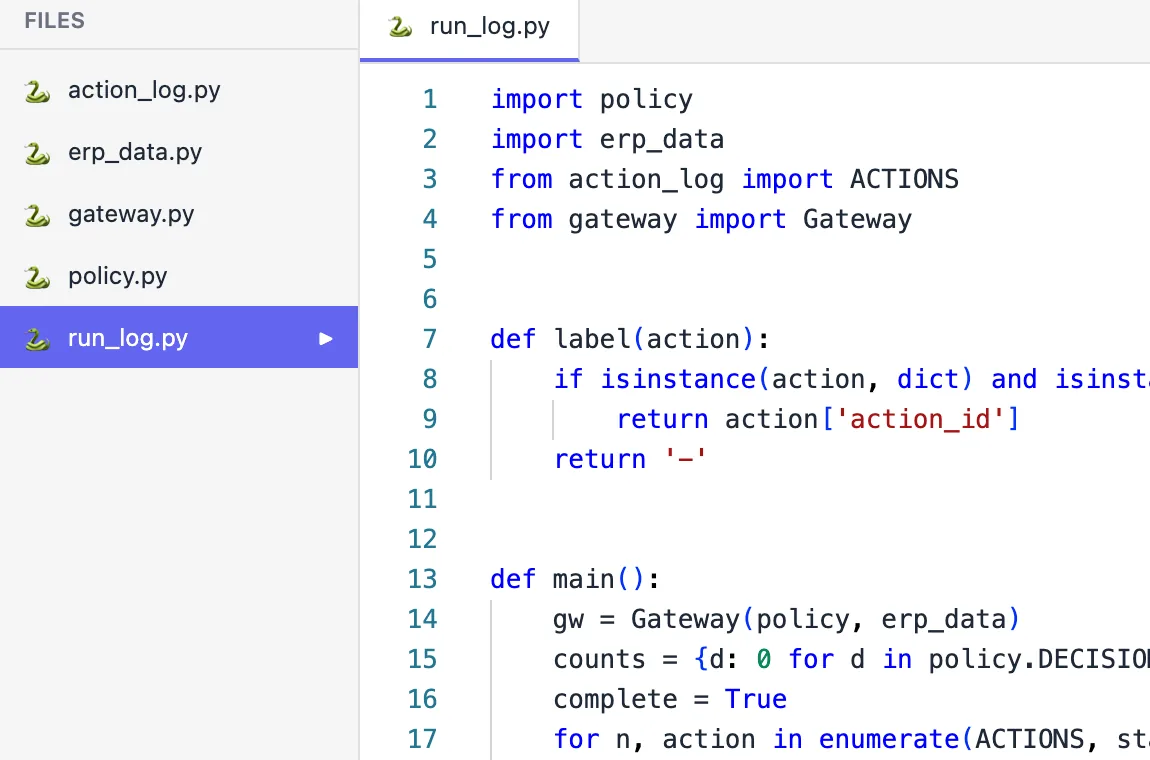
What a strong candidate did: Built a gate that lets low-risk actions through and stops anything irreversible without a person’s approval on record, with tests for each action type.
SQL on the evaluation results, then a written decision
Release gate for an invoice-extraction prompt change
An invoice agent reads supplier invoices and posts them to SAP, or sends them to a person when it cannot post safely. The evals lead needs a ship-or-hold decision on a rewritten extraction prompt.
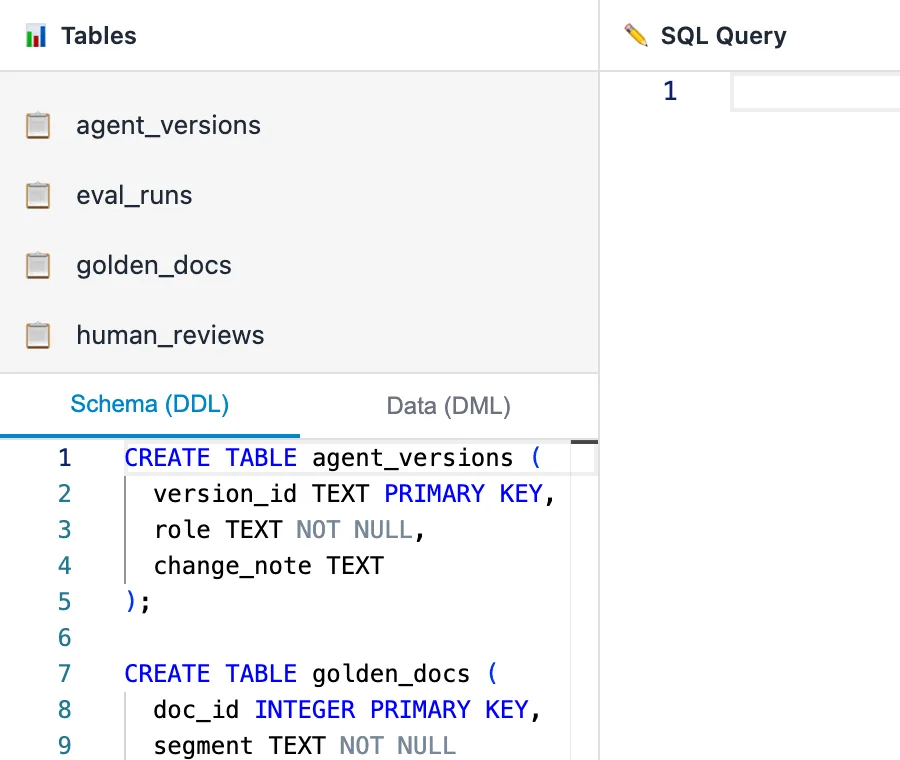
What a strong candidate did: Compared the new prompt with the current one where mistakes cost money, not just on overall accuracy, held the release on a specific failure, and named what would have to change to ship it.
How the decision gets made
In Gateway, each AI engineer candidate works through situations written from your job description, such as filtering retrieval to approved sources, gating an agent's irreversible actions, or deciding whether a prompt change should ship from its evaluation results. The work happens in code and SQL, with a written note explaining the decision. The hiring lead sees every skill scored with written feedback, can open the code and queries read-only, and meets only the engineers whose guardrails would have held.
See your next AI engineer at work before you meet them
Paste your job description and Gateway writes the assessment in about 5 to 10 minutes. Your team can edit every question before it goes out.
Questions
Can candidates use AI tools during the assessment?
You can allow it. An AI-assisted assessment lets the candidate use an assistant, and your team sees how the candidate worked with it. For this role that is often the more realistic test, since the engineer will use one daily.
Will the situations match our use case, such as support, search or document extraction?
Gateway writes each assessment from your job description, so the situations follow the product the AI engineer will work on. Your team can read and edit every question before it goes out.
How is this different from hiring a machine learning engineer?
An AI engineer mostly builds on existing models through retrieval, prompts, evaluation and tool use. The assessment reflects that when the job description does, instead of asking the candidate to train or tune a model.
How long does it take to prepare?
About 5 to 10 minutes from a job description. Candidates get one link and a deadline, and need only a laptop or desktop.
Related