Hire a business intelligence analyst whose Monday numbers leadership can rely on
A business intelligence analyst owns the recurring reporting a business runs on: the KPI dashboards, the weekly review pack and the definitions behind each figure, kept correct every time it refreshes. Dashboard screenshots and Power BI or Tableau certificates look the same from one applicant to the next, so the useful signal is how a candidate investigates a real number that moved, before your team spends time on interviews.
What the hiring manager needs from a business intelligence analyst
The finance, operations or commercial head hiring a business intelligence analyst usually opens the same dashboards every week and takes decisions from them in front of other people. That head needs someone who notices a wrong figure before the meeting does, keeps one version of each KPI, and can say no to a dashboard request that would add a fourth version of the same metric.
The weekly figures are wrong an hour before the review
The overnight refresh partly failed and the sales dashboard shows last week's orders for two regions. A strong business intelligence analyst has checks that catch a stale or partial refresh, flags the affected tiles, and tells the meeting owner what can and cannot be trusted that morning.
Regional heads quoting different totals
Each region's view uses its own filters, currency conversion date or row-level access, so the totals never add up to the company figure. The analyst traces the difference to its cause and makes the regional views reconcile to one number.
A request for one more dashboard
Marketing wants a new conversion dashboard, and three existing ones already show conversion three different ways. The analyst agrees the definition with the owners, retires the duplicates and adds the new view to the agreed source instead of building a fourth.
A KPI target changed in the middle of the quarter
Leadership revised the target and wants performance shown against it. The analyst decides how history is shown, labels the change on the report, and avoids a chart that makes the first half of the quarter look like a sudden collapse.
Where hiring a business intelligence analyst usually goes wrong
- Hiring on dashboard screenshots
- A portfolio of attractive dashboards shows design sense. It does not show whether the figures were right, whether anyone used them, or how the candidate handled the week the refresh failed.
- Treating tool certificates as proof
- Power BI, Tableau and Looker certificates confirm that someone learnt the menus. The weekly review depends on definitions and checks, which no certificate covers.
- Testing DAX or calculated-field trivia
- Formula questions reward memory of syntax. A business intelligence analyst who can explain why the margin tile disagrees with finance's pack is worth more than one who recalls every function.
- Not checking how the candidate handles requests
- BI analysts get asked for new reports every week. A candidate who builds every request as asked leaves the team with sprawling, conflicting dashboards a year later.
Real tasks from a Gateway assessment
These come from a Gateway assessment for a data engineer, with the employer’s name taken out. Gateway writes every assessment from your own job description, so the tasks your candidates get are built around your role.
SQL, then a short update
Why did model error jump after the overnight run
Error in the latest model metrics is far higher than last week. The data scientist cannot yet say whether the models got worse or the data feeding them did, and the engineering manager needs an answer before the morning.
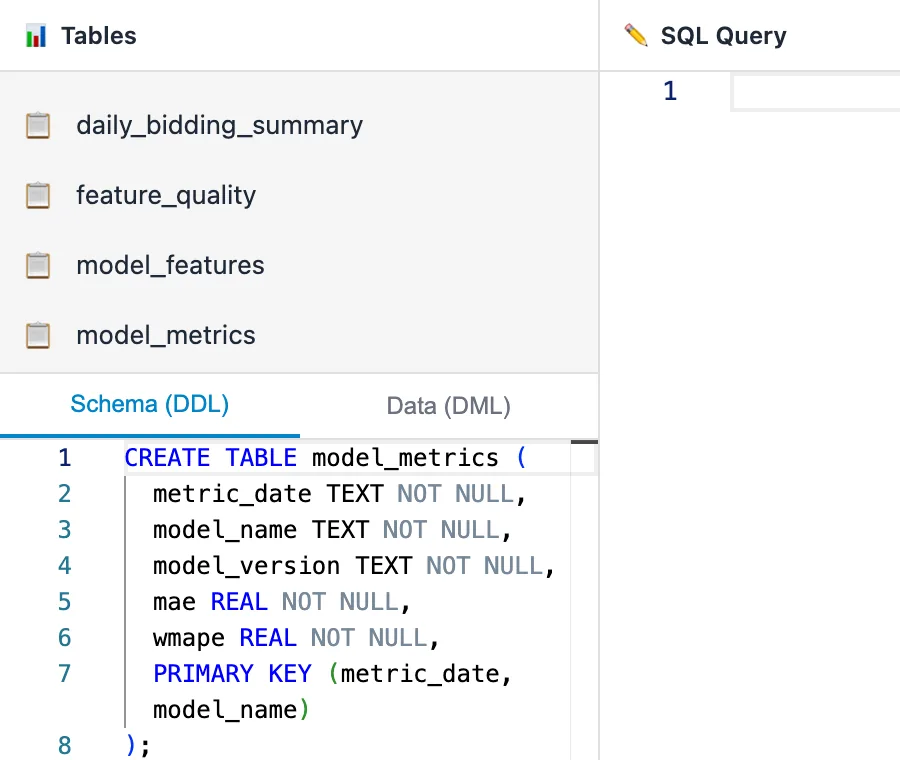
What a strong candidate did: Showed from the data that an upstream feed changed, not the models, pointed to the rows and the time it started, and wrote the update in words the manager could act on.
SQL, then a written note
Inflated spend in a feature table
A strategist summed ad spend from the feature table behind an automated ads optimizer and found it far above the billing report for the same days. A data scientist trains a model on the same table.
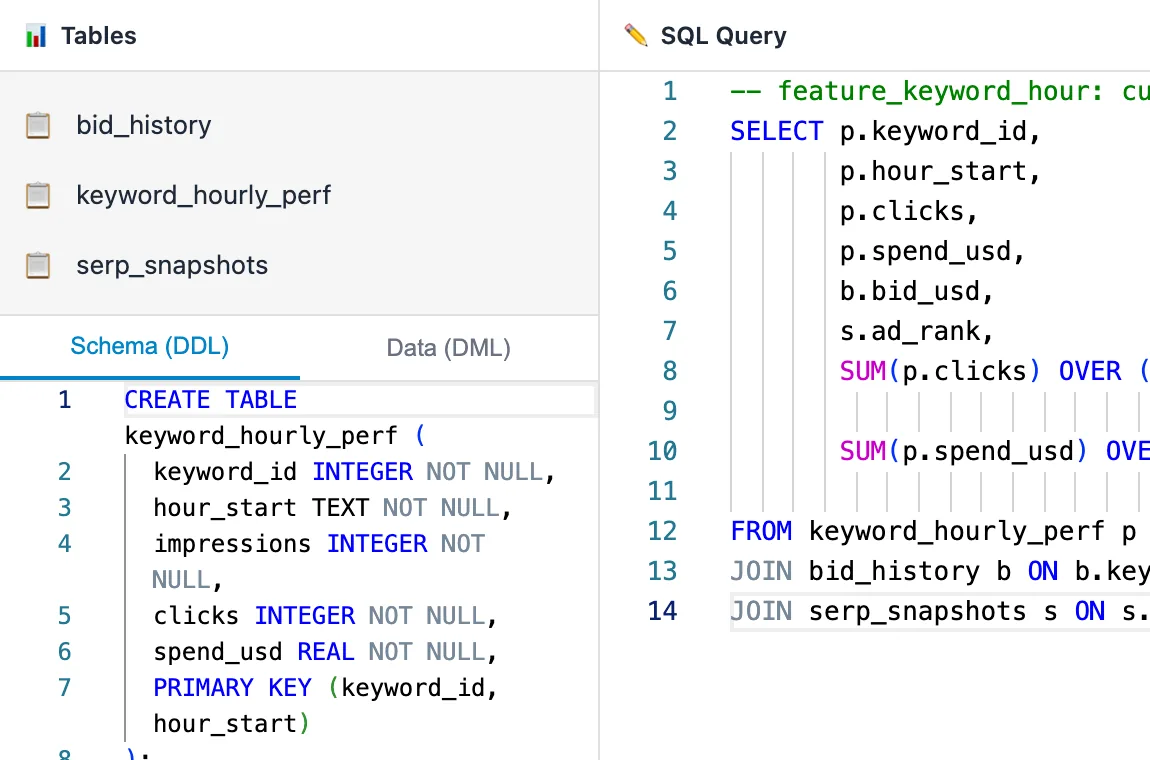
What a strong candidate did: Found the join that multiplied spend, fixed the query so totals tie to billing, and told the data scientist which training days were affected.
How the decision gets made
In Gateway, each business intelligence analyst candidate works through situations written from your job description, such as a metric that jumped after an overnight run or a spend figure that does not tie to billing. The candidate investigates in SQL or a spreadsheet and writes the short update a business head would read before a review. The hiring manager sees each skill scored with written feedback, opens the queries and update read-only, and meets only the analysts who found the cause and explained it plainly.
See your next business intelligence analyst at work before you meet them
Paste your job description and Gateway writes the assessment in about 5 to 10 minutes. Your team can edit every question before it goes out.
Questions
How is a business intelligence analyst assessment different from a data analyst one?
Each assessment comes from its own job description. A business intelligence analyst role built around recurring KPI reporting gets refresh failures, reconciliations and definition disputes, while an ad-hoc analysis role gets open business questions.
Can candidates build or fix a dashboard?
Candidates work in SQL, a spreadsheet, a document or slides. Most of the judgement in BI work shows in finding why a figure is wrong and explaining it, which those tools capture directly.
Can the business owner of the reports review the results?
Yes. Results can be shared with a hiring manager with a note, and the candidate's work opens read-only. Your team can change any score and makes the final decision.
We get many applicants for BI roles. Can we send the assessment to all of them?
Yes. Add candidates from an ATS export, a spreadsheet or resumes; each gets one link and a deadline, and you see who meets your line.
Related