Hire a MongoDB developer who designs documents for the way you query
A MongoDB developer earns the role by shaping documents, indexes and aggregation pipelines around how the application actually reads and writes data, so collections stay fast and consistent as they grow. A flexible schema makes weak design easy to hide on a resume, so the way to separate candidates is to see each one model and query a real case before your team schedules interviews.
What the hiring manager needs from a MongoDB developer
Teams hiring a MongoDB developer often chose the database for speed of development and now feel the cost: documents that keep growing, fields that mean different things in different records, and queries that scan whole collections. The engineering lead needs someone who brings structure back without a painful migration.
Embed or reference, decided for real
An order document embeds the full customer record, so changing a customer's address means updating every order that customer ever placed. The developer decides what belongs inside the document and what should be a reference, based on how often each piece changes and how it is read.
An aggregation pipeline that has become slow
A reporting pipeline with many stages now takes long enough that users refresh the page. A good MongoDB developer moves the $match and $project stages early so indexes can help, checks the explain output, and avoids an $unwind that multiplies documents for no reason.
Fields that drifted across versions of the app
Older records store a price as a string, newer ones as a number, and some have no currency at all. The developer adds schema validation for new writes, plans a backfill for old ones, and keeps the application reading both until the backfill is done.
Choosing a shard key before it is too late
One collection is heading for a size where a single replica set will struggle. The developer picks a shard key that spreads writes and still serves the main queries, knowing that a monotonically increasing key would send every insert to one shard.
Where hiring a MongoDB developer usually goes wrong
- Treating MongoDB as tables without joins
- Candidates from a relational background sometimes copy a normalised schema into collections and then rebuild joins with $lookup everywhere. The resume says MongoDB; the design says otherwise, and only real modelling work shows it.
- Assuming no schema means no design
- A candidate who says the database is schemaless and moves on will leave you with inconsistent documents. Ask how validation, versioning and migrations will work, and listen for a concrete plan.
- Skipping indexes in the interview
- Compound index order, covered queries and the cost of too many indexes are where MongoDB performance is won or lost. A conversation about features rarely reaches them; a slow query in front of the candidate does.
Real tasks from a Gateway assessment
These come from a Gateway assessment for a data engineer, with the employer’s name taken out. Gateway writes every assessment from your own job description, so the tasks your candidates get are built around your role.
Code, then a short note
Gate and deduplicate outbound bid changes
A pipeline pushes bid and budget changes to an ads API every 15 minutes. A rerun pushed the same edits twice, and a broken join once sent zero bids live. The strategist also wants good edits to go through when one bad edit is stopped.
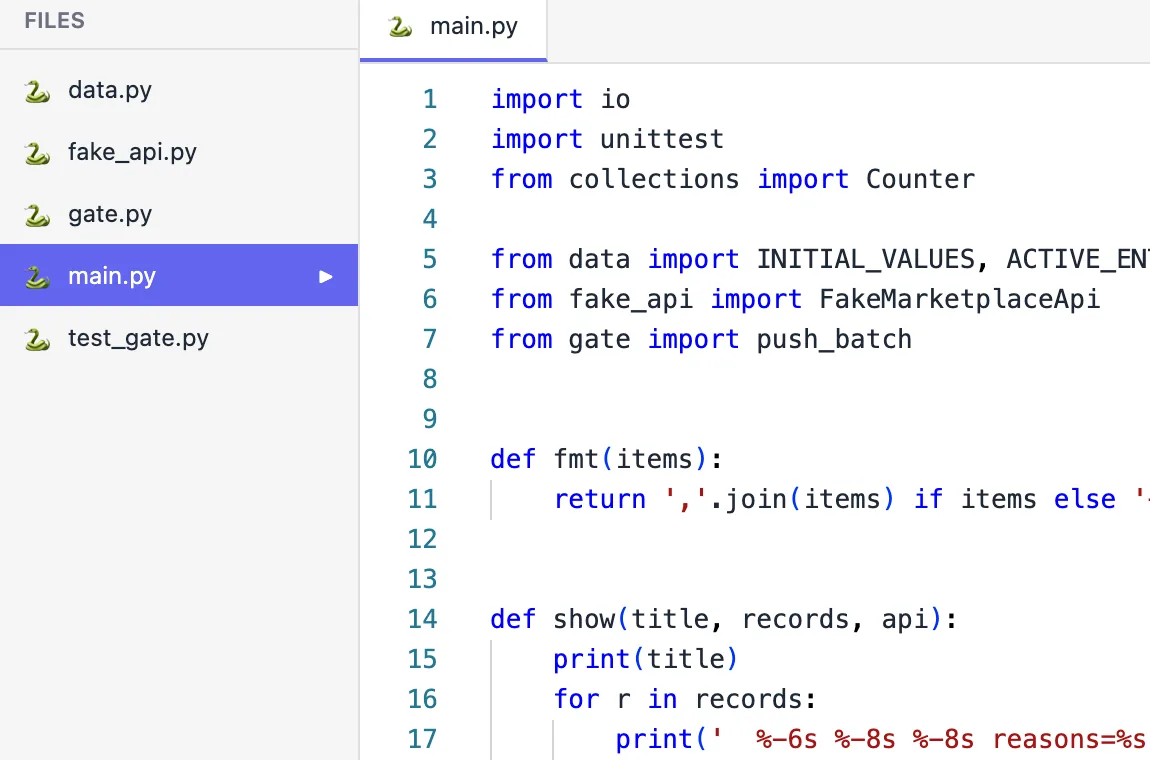
What a strong candidate did: Made each push safe to rerun, stopped bad values one edit at a time instead of the whole batch, and logged what was held and why.
SQL, then a written note
Inflated spend in a feature table
A strategist summed ad spend from the feature table behind an automated ads optimizer and found it far above the billing report for the same days. A data scientist trains a model on the same table.
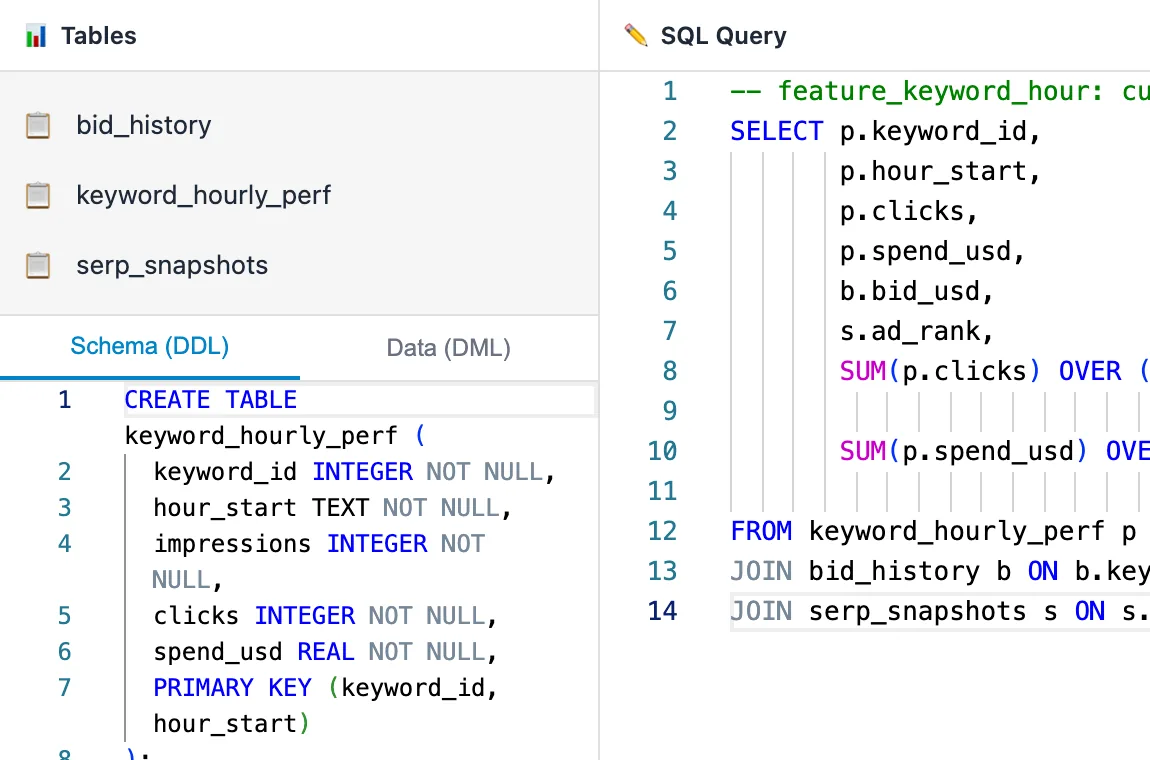
What a strong candidate did: Found the join that multiplied spend, fixed the query so totals tie to billing, and told the data scientist which training days were affected.
How the decision gets made
In Gateway, MongoDB developer candidates get situations written from your job description: a collection to remodel, a pipeline that is too slow, a data quality problem to trace. They write the queries and pipelines in code, sketch the document model on a whiteboard, and explain the trade-offs in a short note. The hiring manager sees scores and written feedback per skill, opens the model and code read-only, and talks only to developers whose design would hold up in your application.
See your next MongoDB developer at work before you meet them
Paste your job description and Gateway writes the assessment in about 5 to 10 minutes. Your team can edit every question before it goes out.
Questions
Can candidates write aggregation pipelines in the assessment?
Yes. Candidates work in code for pipelines and queries and can sketch the document model on a whiteboard in the same assessment, so you see the design and the code that depends on it.
Our product uses MongoDB alongside a relational database. Can the test cover both?
The assessment follows your job description. It can include a SQL step for the relational side and a code step for MongoDB, and your team can edit any question before sending it.
How do we know the candidate wrote the design without help?
You can turn on monitoring at one of four levels, from activity only to camera on, and watch a replay. Gateway flags nothing as cheating by itself; your team reviews anything that looks unusual.
Can the hiring manager see the reasoning, not just a score?
Each skill comes with written feedback explaining the score, and the candidate's whiteboard and code open read-only. Your team can adjust any score before deciding.
Related