Hire a PostgreSQL developer who ships schema changes without locking production
A PostgreSQL developer is worth hiring when the schema, queries and migrations in the developer's care stay fast and safe as the application grows, and production never stalls because of a change that went out. Experience with Postgres is common on resumes, so the reliable way to compare candidates is to see each one read a plan, fix a query and plan a migration on a real case before interviews.
What the hiring manager needs from a PostgreSQL developer
Product teams that build on PostgreSQL usually reach a point where the database stops forgiving shortcuts: tables in the hundreds of millions of rows, JSONB columns used as a second schema, and migrations that take locks during business hours. The engineering lead needs a developer who knows how Postgres behaves under load, not only how to write SQL for it.
A migration that would lock a busy table
A new non-null column with a default, or an index on a large table, is ready to merge. The PostgreSQL developer splits it into steps, uses CREATE INDEX CONCURRENTLY, sets a lock timeout, and plans the backfill in batches so writes keep flowing.
EXPLAIN ANALYZE shows a plan nobody expected
A query that used an index yesterday now does a sequential scan. The developer checks row estimates against actual rows, looks at stale statistics or a parameter that changed selectivity, and fixes the cause rather than forcing the planner.
Bloat and autovacuum falling behind
A heavily updated table keeps growing on disk while row counts stay flat. The developer reads the dead tuple counts, tunes autovacuum for that table, and looks for the long-running transaction that is holding cleanup back.
Too many connections from the application
A new service scaled out and Postgres hit its connection limit. The developer explains why each connection costs memory, puts a pooler such as PgBouncer in the right mode, and checks that the application does not rely on session state the pooler will break.
Where hiring a PostgreSQL developer usually goes wrong
- Equating an ORM with Postgres knowledge
- Many candidates have used PostgreSQL only through an ORM that hid the SQL. That is fine until a generated query does a nested loop over two large tables, and the person hired cannot read the plan to see why.
- Not asking about locks and transactions
- Isolation levels, row locks and lock queues decide whether a deploy is quiet or an outage. Interviews about features rarely touch them, and the gap only appears the first time a migration blocks every write.
- Hiring on extension name-dropping
- Mentioning PostGIS, TimescaleDB or pg_partman shows awareness. Whether the candidate would choose partitioning for the right reason, or reach for an extension to avoid fixing a query, needs a real problem to show.
Real tasks from a Gateway assessment
These come from a Gateway assessment for a data engineer, with the employer’s name taken out. Gateway writes every assessment from your own job description, so the tasks your candidates get are built around your role.
SQL, then a short update
Why did model error jump after the overnight run
Error in the latest model metrics is far higher than last week. The data scientist cannot yet say whether the models got worse or the data feeding them did, and the engineering manager needs an answer before the morning.
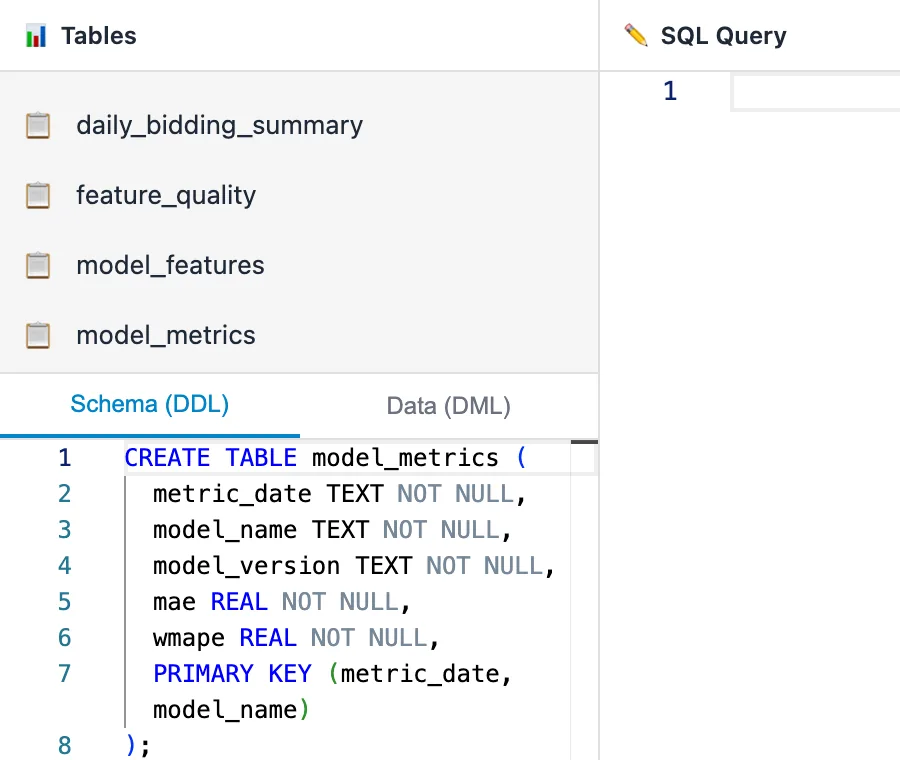
What a strong candidate did: Showed from the data that an upstream feed changed, not the models, pointed to the rows and the time it started, and wrote the update in words the manager could act on.
SQL, then a written note
Inflated spend in a feature table
A strategist summed ad spend from the feature table behind an automated ads optimizer and found it far above the billing report for the same days. A data scientist trains a model on the same table.
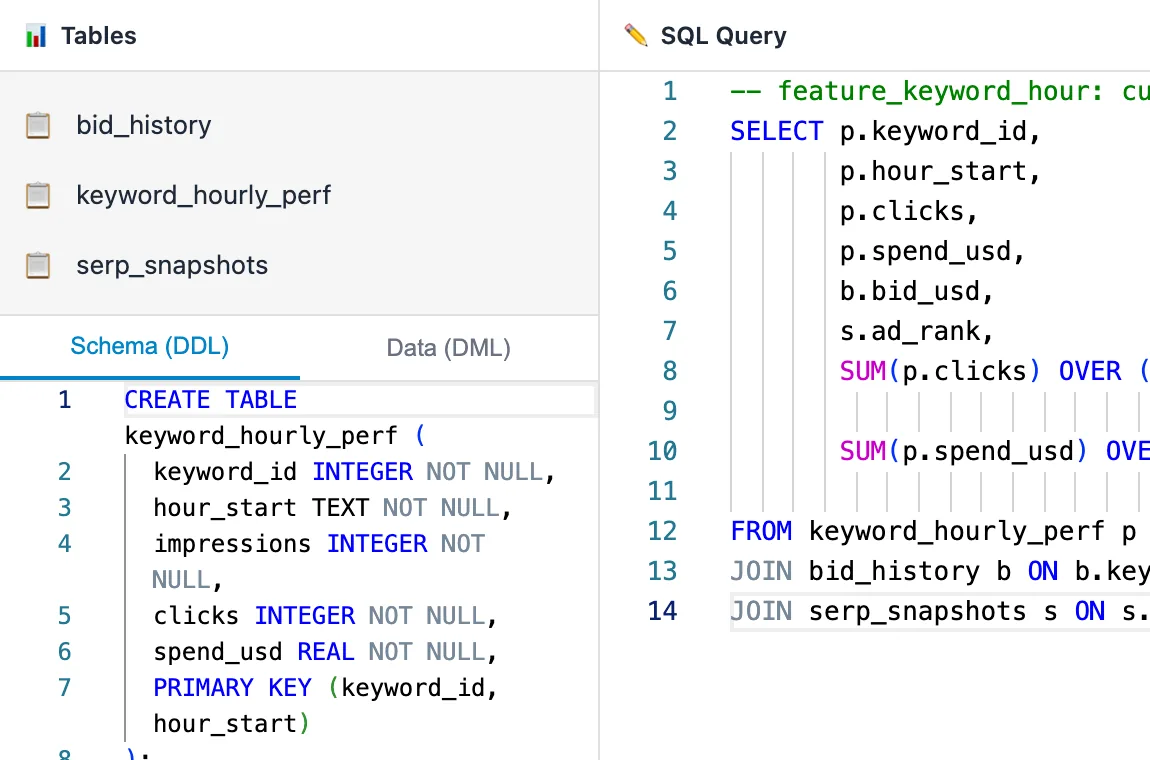
What a strong candidate did: Found the join that multiplied spend, fixed the query so totals tie to billing, and told the data scientist which training days were affected.
How the decision gets made
With Gateway, PostgreSQL developer candidates work on situations taken from your job description: tracing an incorrect total in SQL, explaining a slow plan, writing the steps for a risky migration. They query in a SQL workspace, write code where the change lives in the application, and leave a note your lead can review. The hiring manager sees each skill scored with the reason given, opens every query and note read-only, and interviews the developers who already showed they understand how Postgres behaves with real data.
See your next PostgreSQL developer at work before you meet them
Paste your job description and Gateway writes the assessment in about 5 to 10 minutes. Your team can edit every question before it goes out.
Questions
Can we include our own migration rules or tooling in the test?
Yes. Gateway drafts the assessment from your job description and your team can edit every question before it goes out, so you can describe your migration tool, your table sizes and the rules your team follows.
Will candidates read real query plans?
You can include a plan for the candidate to interpret, or ask the candidate to write a query and explain how Postgres will execute it. The SQL and the explanation open read-only for your reviewers.
Can a candidate use an AI assistant, since our team does?
Run an AI-assisted assessment and the candidate may use an assistant. Your team sees how the candidate worked with it, including whether a suggested migration was checked for locking before it was accepted.
Who makes the final call?
Your team. Gateway gives a score and written feedback for each skill, a tier from 1 to 5 and whether the candidate meets your line, and anyone reviewing can change a score.
Related