Hire a data scientist whose models survive contact with the business
A good data scientist frames a business decision as a prediction or an experiment, picks a measure that reflects what a mistake actually costs, and says plainly when a model is not worth shipping. Certificates and competition ranks look alike across applicants, so the reliable signal is a candidate reading real evaluation results and making a ship-or-hold call before your team books interviews.
What the hiring manager needs from a data scientist
The head of data or product hiring a data scientist usually has a decision that depends on a forecast or a test: which customers will leave, whether a pricing change worked, whether a model can replace a manual review. The manager needs someone who can tell a real effect from noise, catch a model that only looks good offline, and explain the result to people who will never read the code.
An A/B test that "won" after the team kept peeking
Product checked the experiment every morning and stopped it the day the lift crossed significance. A strong data scientist checks whether the groups were split as designed, whether the early lift is novelty, and whether stopping on a good day inflated the result, then says what the team can honestly claim.
A churn model that was excellent offline and useless in production
The validation score was high, and live predictions barely beat a coin toss. The usual cause is a feature that was only known after the customer had already left. The data scientist you want finds that leak in the feature definitions before retraining anything.
Accuracy that hides the expensive mistakes
A missed fraud case costs far more than a wrongly flagged one, and a retention discount sent to a loyal customer is money given away. The data scientist sets the threshold from those costs, with the business owner, instead of reporting one accuracy figure that treats every error as equal.
Leadership asking whether the campaign caused the lift
Sales rose in the weeks after a launch, during the season when sales always rise. The data scientist separates what the campaign did from what the calendar did, states the assumptions behind the estimate, and avoids a confident causal claim the data cannot support.
Where hiring a data scientist usually goes wrong
- Hiring on Kaggle ranks and course certificates
- Competitions hand the candidate a fixed target, a fixed split and a fixed metric, then reward squeezing the last decimal out of it. In the role, choosing the target and the metric is most of the work, and a leaderboard says nothing about that.
- Statistics trivia in the interview
- Defining a p-value from memory is different from noticing that an experiment was stopped early or that two groups were not comparable. Many candidates pass the definition round and then sign off on a test result that will not hold.
- Take-homes with the label already defined
- A dataset with a tidy target column skips the hardest question: what exactly counts as churn, fraud or conversion, and when is it known. Candidates who only meet prepared labels rarely spot leakage in yours.
- Mistaking a complex model for a good one
- A stacked ensemble with a slightly higher score can lose to a simple model that product can understand, monitor and retrain. Hiring the person with the most elaborate pipeline often means hiring someone who cannot say when simpler is enough.
Real tasks from a Gateway assessment
These come from a Gateway assessment for an AI engineer, with the employer’s name taken out. Gateway writes every assessment from your own job description, so the tasks your candidates get are built around your role.
SQL on the evaluation results, then a written decision
Release gate for an invoice-extraction prompt change
An invoice agent reads supplier invoices and posts them to SAP, or sends them to a person when it cannot post safely. The evals lead needs a ship-or-hold decision on a rewritten extraction prompt.
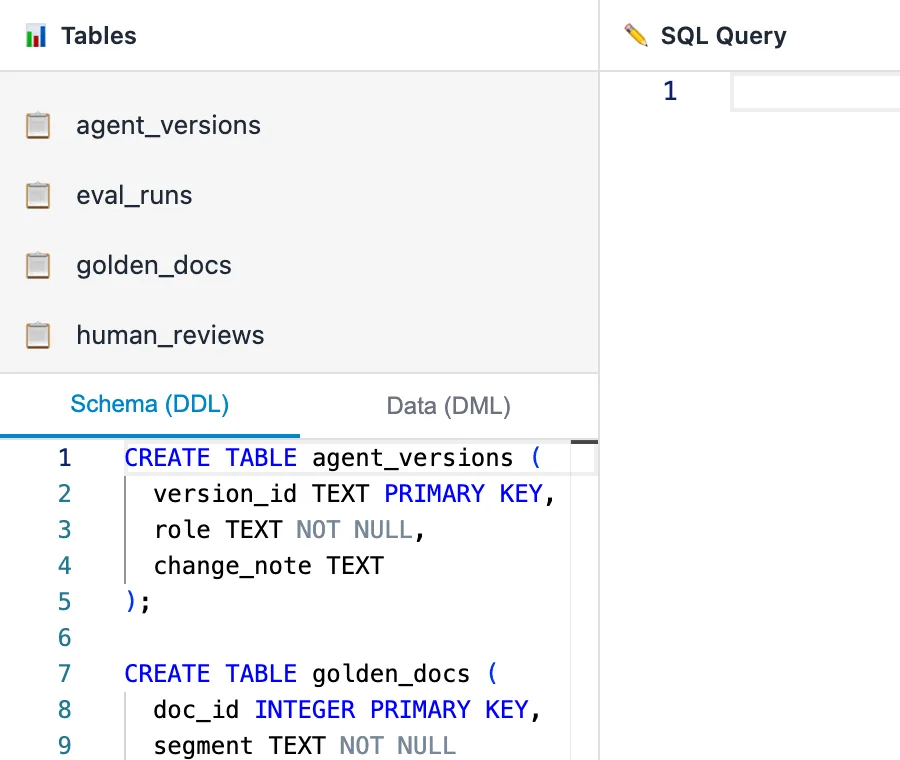
What a strong candidate did: Compared the new prompt with the current one where mistakes cost money, not just on overall accuracy, held the release on a specific failure, and named what would have to change to ship it.
Code, then a written note
Retrieval filter and safety gate for a health assistant
A patient-facing assistant answers questions about diabetes care from approved guideline text. It must never answer from text it should not use, and must hand off questions it should not answer.
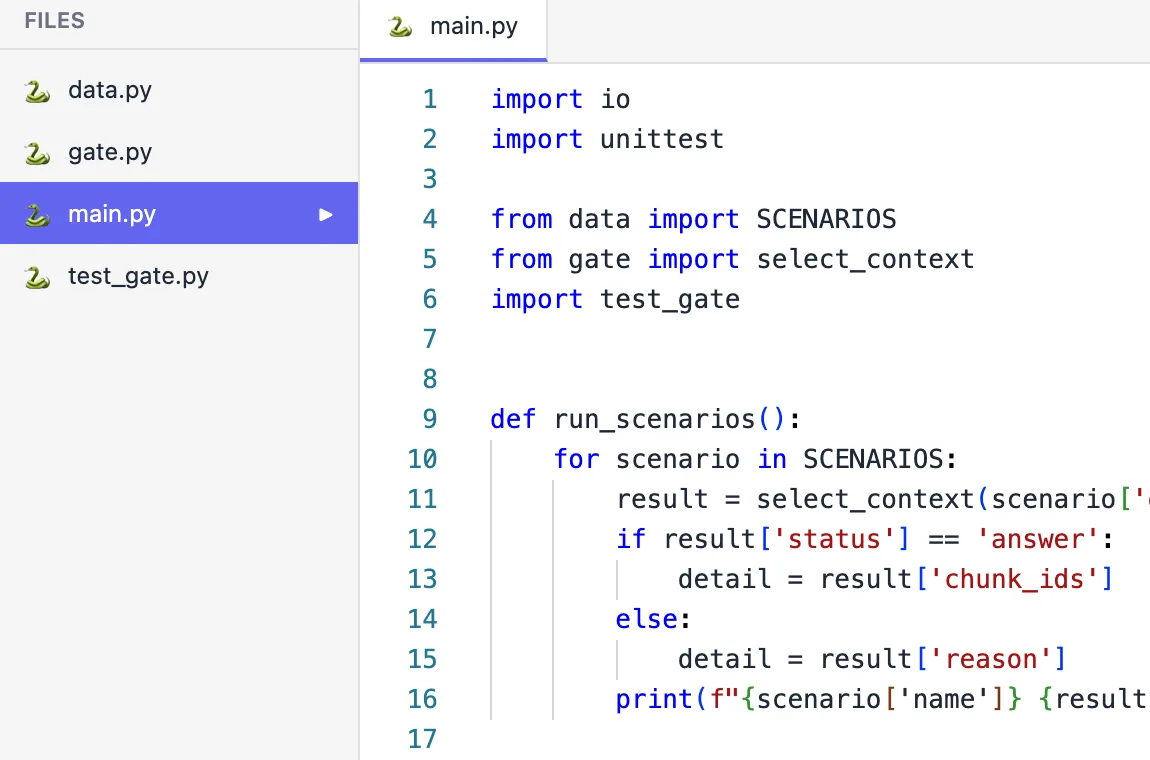
What a strong candidate did: Filtered retrieval to approved, current sources only, added a gate that routes medication and emergency questions to a clinician, and tested both with real-looking questions.
How the decision gets made
In Gateway, each data scientist candidate works on situations written from your job description, such as comparing a new model against the current one on evaluation results, or deciding whether a model's output is safe to act on. The candidate queries the results in SQL or writes code, then writes the decision and the reasoning. The hiring manager sees a score and written feedback for each skill, a tier from 1 to 5 and whether the candidate meets your line, and can open every query and note read-only. The interviews that follow are about judgement the candidate has already shown.
See your next data scientist at work before you meet them
Paste your job description and Gateway writes the assessment in about 5 to 10 minutes. Your team can edit every question before it goes out.
Questions
Our data scientists mostly run experiments, not models. Can the assessment reflect that?
Yes. Gateway writes the assessment from your job description, so a role built around experiments gets experiment readouts and decisions, and a modelling role gets model evaluation. Your team can read and edit every question before it goes out.
Can candidates work in Python as well as SQL?
Candidates can work in code, SQL, a spreadsheet or a written document within the same assessment, so you see the analysis and the explanation of it together.
There is rarely one right answer in this work. How is it scored?
Each skill gets a score with written feedback that gives the reason, so the hiring manager can see why a ship-or-hold call was judged sound or weak. Your team can change any score and makes the final decision.
Can candidates use an AI assistant, since our team does?
You choose. In an AI-assisted assessment the candidate may use an assistant and your team sees how the candidate worked with it, including whether the candidate checked what it produced.
How much time does it take to set up?
About 5 to 10 minutes from a job description. Review the situations, adjust anything, and send each candidate one link with a deadline.
Related