Hire a deep learning engineer who can tell a better network from a lucky run
A deep learning engineer trains, fine-tunes and compresses neural networks for vision, speech or language, and has to know when a gain on the validation set will hold on the data the product actually sees. Paper lists and architecture names do not show that judgement, so the way to compare candidates is to have each one read real evaluation results and decide what ships before your team runs interviews.
What the hiring manager needs from a deep learning engineer
The research or ML lead hiring a deep learning engineer is spending real money on compute and labelling. The lead needs someone who can diagnose a training run that went wrong, build an evaluation that reflects the field rather than the lab, and get a large model small and fast enough for its target hardware.
A fine-tune whose loss blows up halfway through
The run was stable for hours, then the loss spiked and never recovered. A strong deep learning engineer checks the learning-rate schedule, a corrupt batch, mixed-precision overflow and gradient norms in that order, and restarts from a checkpoint with a fix rather than simply lowering the learning rate and rerunning.
A vision model that fails on images from a new site
Validation accuracy was high because the validation images came from the same cameras and lighting as training. On a new site the model degrades. The engineer builds a held-out set that reflects the new conditions and measures there before claiming anything.
A model too large for the device it has to run on
The product needs inference on an edge device or within a tight serving budget. The engineer tries quantization, distillation or a smaller backbone, measures the accuracy lost on the classes that matter most, and reports the trade-off rather than a single headline number.
A labelling budget that has to be spent well
Labels are slow and expensive, and some existing ones are wrong. The engineer finds the noisy labels that hurt most, decides which new examples to label first, and can show the effect on the evaluation set.
Where hiring a deep learning engineer usually goes wrong
- Hiring on papers and architecture names
- Transformers, diffusion models and vision backbones appear on many resumes. Knowing an architecture is different from noticing that a validation set shares patients, speakers or cameras with the training set.
- Whiteboard derivations
- Deriving backpropagation by hand tests coursework. The expensive mistakes in this role are a wasted training run and an evaluation that flatters the model, and neither shows up in a derivation.
- Equating compute hours with judgement
- A candidate who has trained on large clusters may still read a loss curve poorly or choose the winning checkpoint by its test-set score. Scale of past runs says little about the discipline behind them.
- Never testing how results are reported
- A lead acts on the engineer's summary of an experiment. If a candidate reports one aggregate metric and hides the class or segment that got worse, the lead finds out from customers.
Real tasks from a Gateway assessment
These come from a Gateway assessment for an AI engineer, with the employer’s name taken out. Gateway writes every assessment from your own job description, so the tasks your candidates get are built around your role.
SQL on the evaluation results, then a written decision
Release gate for an invoice-extraction prompt change
An invoice agent reads supplier invoices and posts them to SAP, or sends them to a person when it cannot post safely. The evals lead needs a ship-or-hold decision on a rewritten extraction prompt.
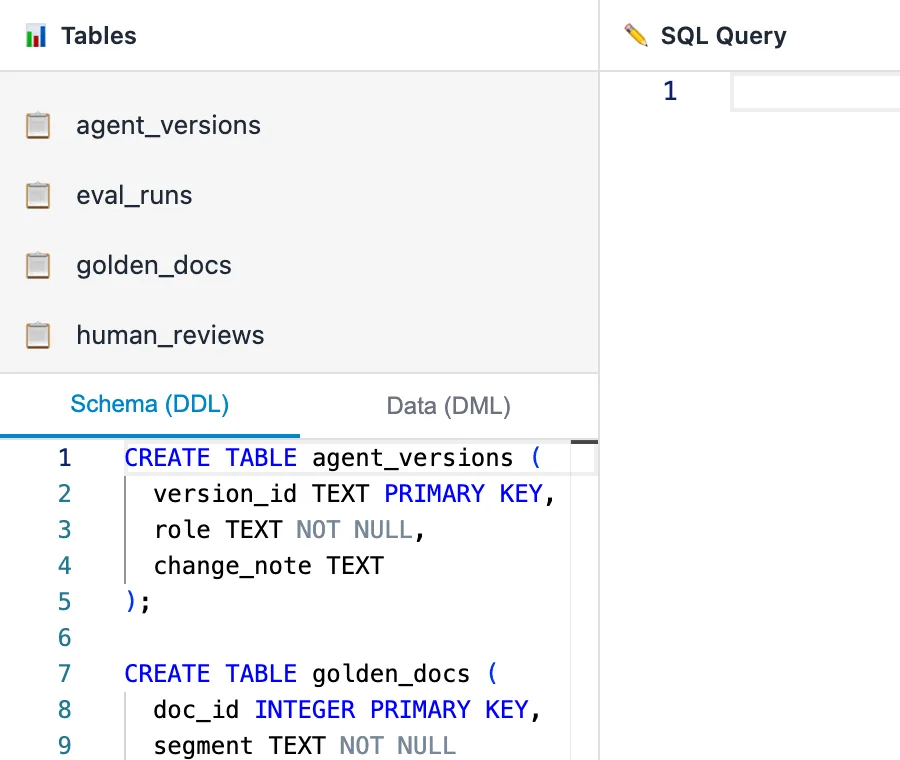
What a strong candidate did: Compared the new prompt with the current one where mistakes cost money, not just on overall accuracy, held the release on a specific failure, and named what would have to change to ship it.
Code, then a short note
Release gate for irreversible payments
A payment agent proposes three kinds of action in SAP, including releasing wires that cannot be recalled once a bank accepts them. Treasury carries any loss.
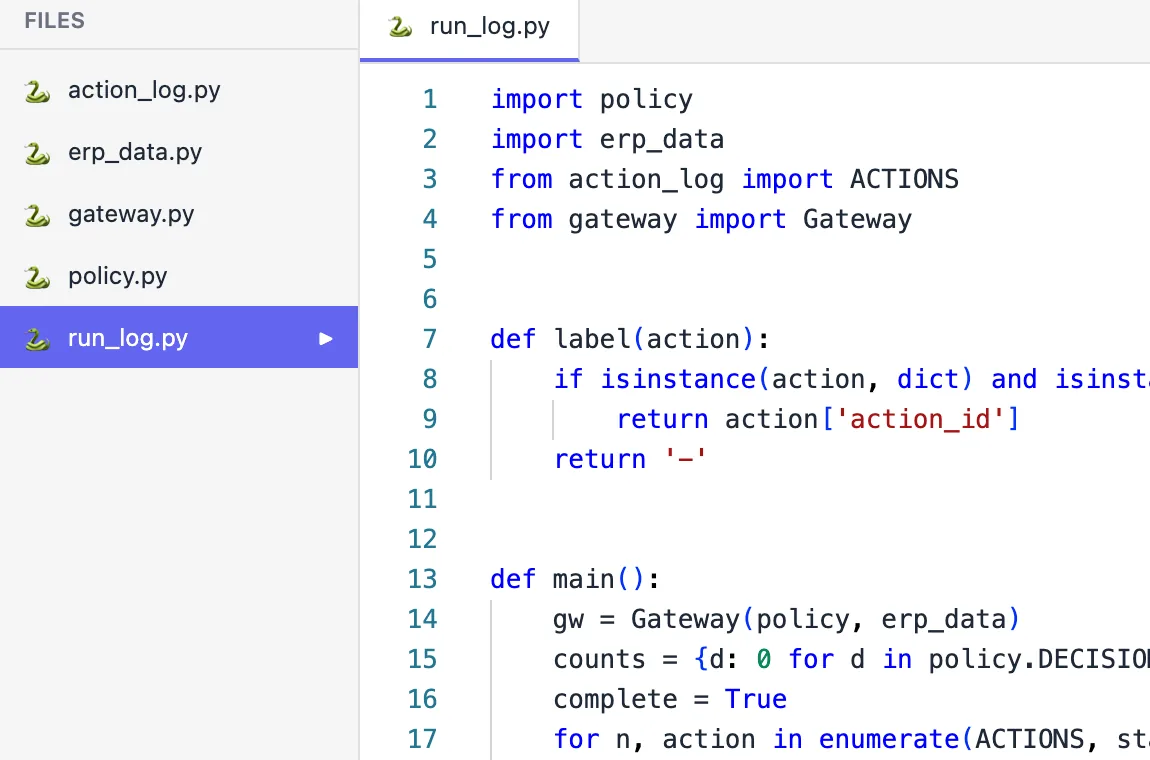
What a strong candidate did: Built a gate that lets low-risk actions through and stops anything irreversible without a person’s approval on record, with tests for each action type.
How the decision gets made
In Gateway, each deep learning engineer candidate works on situations written from your job description, such as comparing a new model against the current one on evaluation results where mistakes have different costs, or writing the code that decides which model outputs may be acted on. The candidate works in SQL or code, then writes a ship-or-hold decision with the reasoning. The hiring lead sees each skill scored with written feedback and can open the queries, code and note read-only, so interviews start from evaluation judgement the candidate has already shown.
See your next deep learning engineer at work before you meet them
Paste your job description and Gateway writes the assessment in about 5 to 10 minutes. Your team can edit every question before it goes out.
Questions
Can the assessment cover our domain, such as medical imaging or speech?
Gateway writes each assessment from your job description, so the situations and data follow the domain and models the role describes. Your team can read and edit every question before it goes out.
Do candidates train a full network during the assessment?
The tasks focus on the decisions around training: reading evaluation results, diagnosing what went wrong and deciding what ships. Candidates need only a laptop or desktop and one link.
How does this differ from our machine learning engineer assessment?
The situations come from each job description. A deep learning role that asks for training, fine-tuning and compression gets those situations, while a machine learning engineer role centred on serving gets production ones.
Can our research lead overrule a score?
Yes. Every skill has a score with written feedback, and your team can change any score and makes the final decision.
Related