Hire an MLOps engineer who makes every model release reproducible and reversible
An MLOps engineer builds the platform that trains, versions, deploys and watches models, so that any model in production can be reproduced, rolled back and checked for drift. Tool names like MLflow or Kubeflow say little on their own, so the useful signal is how a candidate builds a release gate or a safety check on a real situation, seen before your team spends time on interviews.
What the hiring manager needs from an MLOps engineer
The platform or ML lead hiring an MLOps engineer usually has several teams shipping models in several different ways, each with its own scripts. The lead needs one person who can turn that into a standard path with the same checks for every model, and who notices a degrading model before customers do.
Nobody can rebuild last quarter's model
An auditor or a customer asks why a prediction was made, and the training data snapshot, code version and parameters were never recorded together. A strong MLOps engineer sets up a registry and lineage so that every deployed model points to exactly what produced it.
Rolling out a new model version without a bad week
Teams currently replace the model and hope. The MLOps engineer adds a shadow or canary stage, compares live behaviour with the current version, and makes rollback a single step that anyone on call can run.
Drift that shows up before the labels do
Ground truth for a credit or churn model arrives weeks later, so waiting for accuracy to fall is waiting too long. The engineer monitors input distributions and prediction rates, sets alerts that fire on meaningful shifts, and keeps them quiet enough that people still read them.
Inference costs climbing with no owner
GPU endpoints sit idle overnight and every team runs its own serving cluster. The engineer finds which models justify dedicated capacity, consolidates the rest, and shows the cost change without slowing the products that depend on them.
Where hiring an MLOps engineer usually goes wrong
- Hiring a DevOps engineer who has never watched a model decay
- Strong Kubernetes and CI skills cover half the role. A model can pass every health check while its predictions get steadily worse, and a candidate without that experience will build a platform that reports green during a silent failure.
- Hiring a data scientist who once deployed a model
- Wrapping a model in an API for a demo is different from running dozens of models with versioning, access control and rollback. The gap shows the first time two teams need the same platform to behave differently.
- Screening on the tool checklist
- MLflow, Kubeflow, SageMaker, Vertex AI and Airflow appear together on many resumes. The question that matters is whether the candidate can design a release that stops an unsafe model, and the checklist does not answer it.
- No test of what happens when a release goes wrong
- Interviews often walk through a pipeline diagram and never ask how a bad model is stopped or reversed. That is the work the platform lead will lean on this person for.
Real tasks from a Gateway assessment
These come from a Gateway assessment for an AI engineer, with the employer’s name taken out. Gateway writes every assessment from your own job description, so the tasks your candidates get are built around your role.
Code, then a short note
Release gate for irreversible payments
A payment agent proposes three kinds of action in SAP, including releasing wires that cannot be recalled once a bank accepts them. Treasury carries any loss.
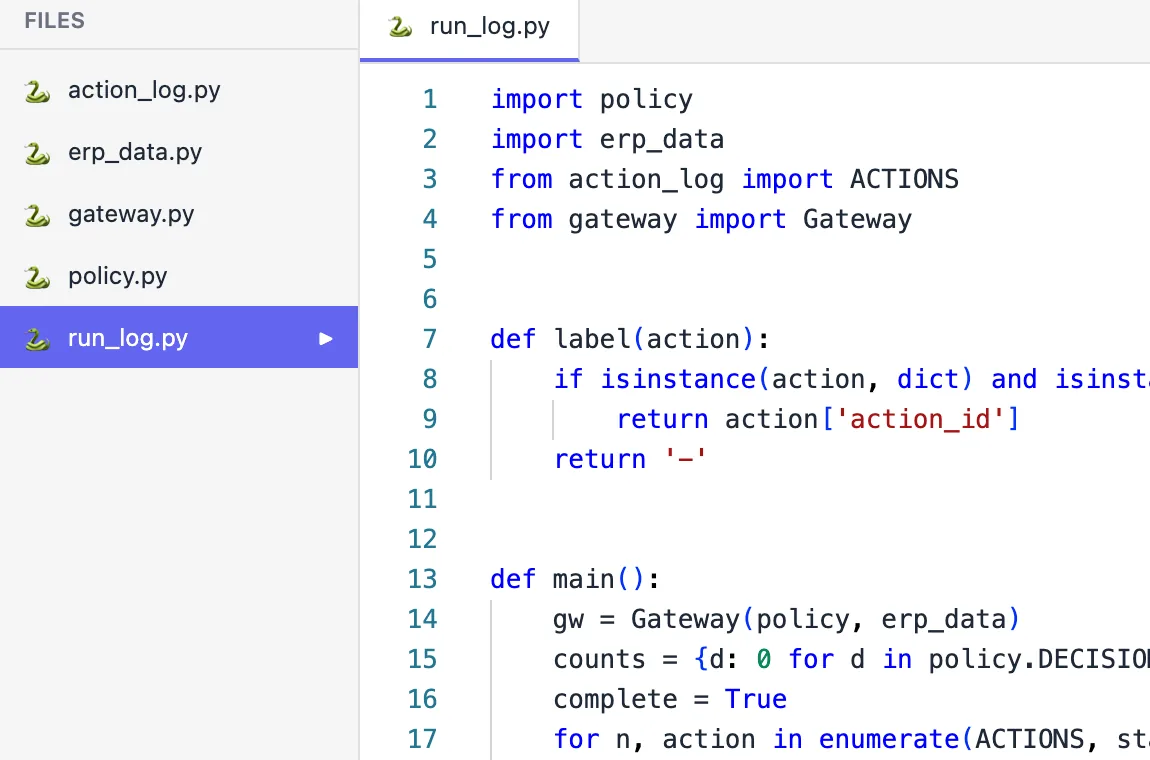
What a strong candidate did: Built a gate that lets low-risk actions through and stops anything irreversible without a person’s approval on record, with tests for each action type.
Code, then a written note
Retrieval filter and safety gate for a health assistant
A patient-facing assistant answers questions about diabetes care from approved guideline text. It must never answer from text it should not use, and must hand off questions it should not answer.
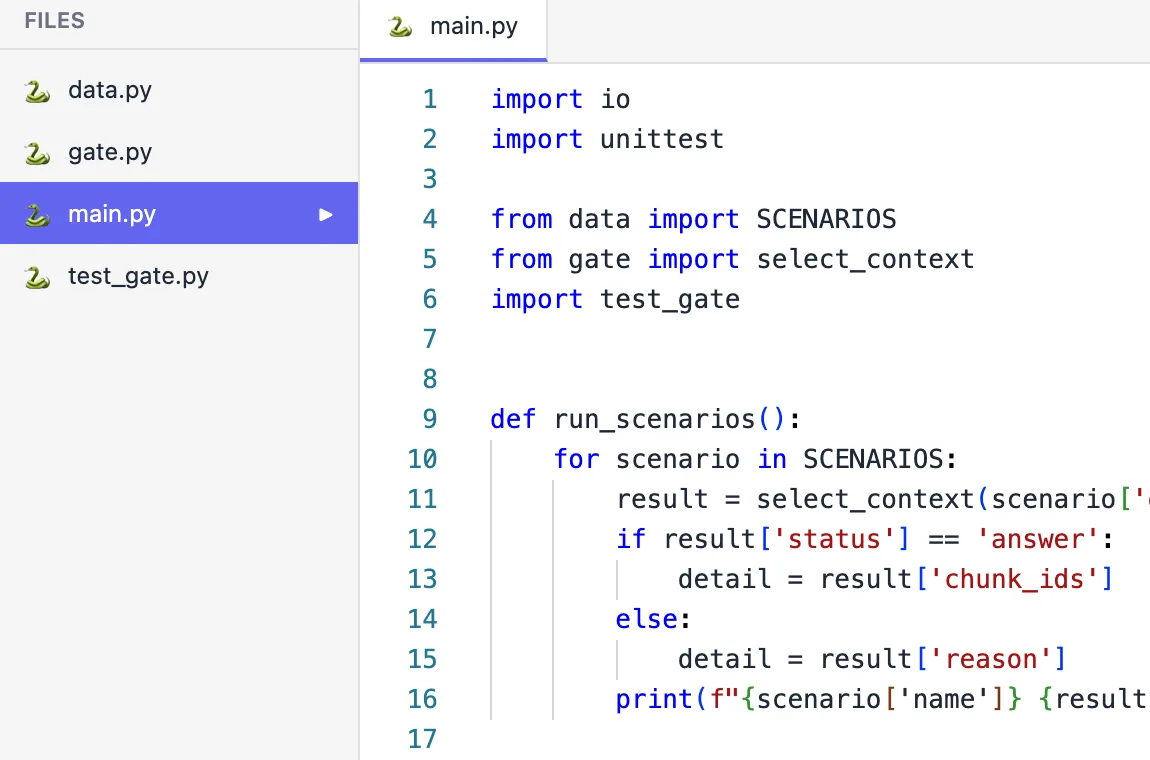
What a strong candidate did: Filtered retrieval to approved, current sources only, added a gate that routes medication and emergency questions to a clinician, and tested both with real-looking questions.
How the decision gets made
In Gateway, each MLOps engineer candidate works on situations written from your job description, such as a release gate that blocks irreversible model-driven actions without a recorded approval, or a filter and safety check on what a model is allowed to use and answer. The candidate writes code with tests and a short note on the design. The platform lead sees a score and written feedback for each skill, opens the code read-only, and interviews only the engineers whose release path would have stopped a bad model.
See your next MLOps engineer at work before you meet them
Paste your job description and Gateway writes the assessment in about 5 to 10 minutes. Your team can edit every question before it goes out.
Questions
Can the assessment follow our platform, such as Kubernetes or a managed ML service?
Gateway writes the assessment from your job description, so the situations reflect the platform and tools the role names. Your team can read and edit every question before it goes out.
Can a candidate draw the platform design instead of only writing code?
Yes. Candidates can work on a whiteboard, in code or in a written document within one assessment, so you can see both the design and an implemented piece of it.
How do we check whether a candidate actually wrote the work?
Monitoring is off by default and has four levels, from activity only to camera on, with a replay of the test. Gateway never marks a candidate as cheating on its own; your team reviews anything unusual.
We are also hiring DevOps engineers. Can both roles share a process?
Each role gets its own assessment written from its own job description, so the MLOps situations stay about models, and you can send both from the same place with one link per candidate.
Related