Hire a Cassandra engineer who designs tables around your queries
A Cassandra engineer is hired to keep a large, write-heavy dataset available across nodes and data centres, with tables designed so every read hits one partition and the cluster stays healthy through compaction and repair. These skills rarely show on a resume, so the way to compare candidates is to see each one model and troubleshoot a real case before your team interviews.
What the hiring manager needs from a Cassandra engineer
Teams choose Cassandra for event streams, time series, messaging or device data that a single relational server could not hold. The lead hiring a Cassandra engineer needs someone who models for the queries first and knows how the cluster behaves when nodes fail, disks fill or deletes pile up, and who can explain those trade-offs to the product team in plain terms.
A query the table was never designed for
Product wants to list a user's events by type, but the table is partitioned by device. The Cassandra engineer designs a new table for that access pattern, plans how both tables are written, and avoids reaching for ALLOW FILTERING or a secondary index that will scan the cluster.
Partitions that grow without limit
One customer's partition keeps growing and reads on it time out. The engineer adds a time bucket to the partition key, works out a bucket size that keeps partitions manageable, and migrates existing data without downtime.
Tombstones slowing every read
A queue-like table with frequent deletes now logs tombstone warnings and slow reads. The engineer explains why the pattern produces tombstones, changes the model or uses TTLs, and checks that gc_grace_seconds fits the repair schedule.
Choosing consistency for each operation
Payments use the same consistency level as analytics events. The engineer sets LOCAL_QUORUM where correctness matters, a lighter level where speed matters, and explains what each choice means when a data centre is unreachable.
Where hiring a Cassandra engineer usually goes wrong
- Hiring a relational modeller for a wide-column store
- Normalising data and joining at read time is the habit that hurts most in Cassandra. A candidate who designs tables first and queries later will build something that works in testing and breaks at scale.
- Never discussing repair and compaction
- Clusters stay consistent only if repairs run and compaction keeps up. Candidates who have only written application code against Cassandra may never have seen these, and your on-call rota will find out the hard way.
- Overvaluing years over scale
- Several years on a small cluster can teach less than one year on a large, multi-region one. Ask the candidate to reason about a problem at your size, and the depth shows quickly.
Real tasks from a Gateway assessment
These come from a Gateway assessment for a data engineer, with the employer’s name taken out. Gateway writes every assessment from your own job description, so the tasks your candidates get are built around your role.
Code, then a short note
Gate and deduplicate outbound bid changes
A pipeline pushes bid and budget changes to an ads API every 15 minutes. A rerun pushed the same edits twice, and a broken join once sent zero bids live. The strategist also wants good edits to go through when one bad edit is stopped.
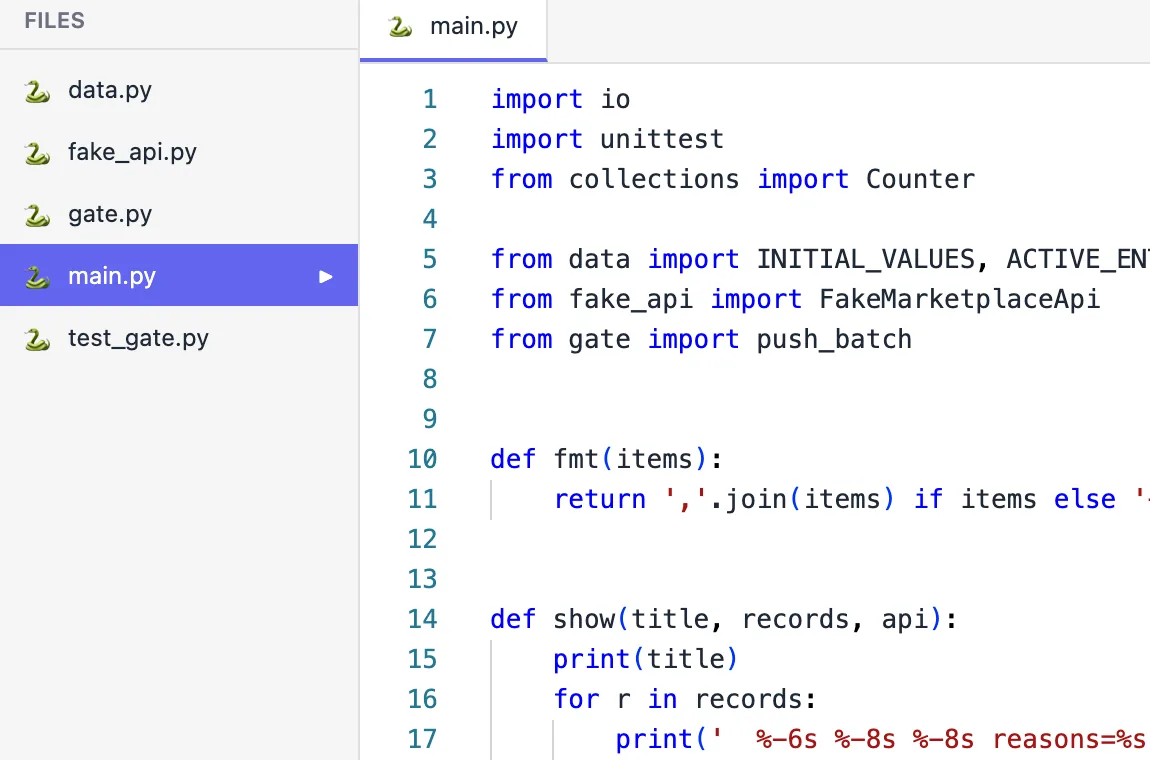
What a strong candidate did: Made each push safe to rerun, stopped bad values one edit at a time instead of the whole batch, and logged what was held and why.
SQL, then a short update
Why did model error jump after the overnight run
Error in the latest model metrics is far higher than last week. The data scientist cannot yet say whether the models got worse or the data feeding them did, and the engineering manager needs an answer before the morning.
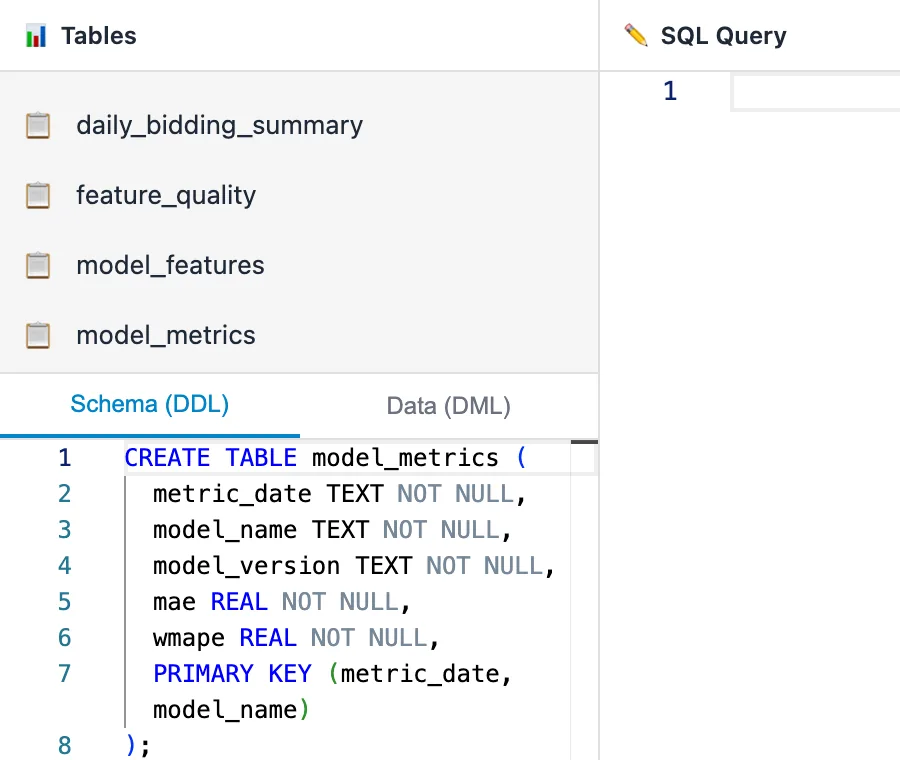
What a strong candidate did: Showed from the data that an upstream feed changed, not the models, pointed to the rows and the time it started, and wrote the update in words the manager could act on.
How the decision gets made
With Gateway, Cassandra engineer candidates get situations written from your job description: a push to an external API that must be safe to rerun, a metrics jump that may come from upstream data, a table to redesign for a new query. They write code, sketch partition and table designs on a whiteboard, and explain trade-offs in a note. The hiring manager sees each skill scored with written reasons, opens the designs and code read-only, and spends interviews on engineers whose models fit your access patterns.
See your next Cassandra engineer at work before you meet them
Paste your job description and Gateway writes the assessment in about 5 to 10 minutes. Your team can edit every question before it goes out.
Questions
Can candidates write CQL and table designs?
Candidates can write CQL and supporting code in the code step and draw partition layouts on a whiteboard. Your team sees both, read-only, next to the score for each skill.
Can the assessment use our data, such as device events or messages?
The situations come from your job description, so they follow your domain. Your team reads and edits every question before any candidate receives it.
We need someone for operations more than development. Does that work?
Yes. Describe the operational duties in the job description, such as repair, capacity and node replacement, and the situations will lean that way. You can also add a recorded walkthrough step where the candidate talks through a runbook.
Does Gateway decide who passes?
It suggests a tier from 1 to 5 and whether the candidate meets your line, with written feedback per skill. Your team can change any score and makes the decision.
Related