Hire an API developer whose integrations keep working when partners change
An API developer builds and maintains the contracts other people depend on: partner integrations, webhooks, the endpoints a mobile app calls and the third-party APIs your product consumes. The way to tell candidates apart is to see each one handle a real integration problem, retries, bad partner data and all, before your team commits interview time.
What the hiring manager needs from an API developer
Employers hiring an API developer usually have integrations at the centre of the product: payment providers, partner platforms, internal consumers and customers building on top of the API. The engineering manager needs someone who treats every endpoint as a promise, and who can deal with the other side's API being slow, badly documented or wrong.
A partner integration with thin documentation
The partner's API docs are out of date and the sandbox behaves differently from production. The API developer probes the real behaviour, writes down what was learned, and builds the client so an unexpected field or a slow response does not take your product down with it.
Webhooks from a provider that retries
Providers resend events when they get no answer in time, and send them out of order. The developer makes the receiving endpoint safe to call twice and returns the right response quickly so the provider stops retrying.
A change the mobile app cannot absorb
A field needs to change shape, and older app versions in customers' pockets still call the old contract. The API developer adds the new behaviour without breaking the old one, deprecates on a timeline, and tells the consuming teams in writing.
Giving partners access without giving away too much
A new partner needs keys or OAuth access to a subset of data. The developer scopes the access, adds rate limits that protect the service, and makes errors clear enough that the partner's engineers do not need a call to understand them.
Where hiring an API developer usually goes wrong
- Equating an API developer with any backend engineer
- Building endpoints for your own frontend is a different discipline from maintaining contracts that outside teams depend on. Candidates whose only consumers sat in the same team, and could be asked to redeploy, often miss versioning and compatibility entirely.
- Accepting Postman screenshots as integration experience
- Calling an API successfully once is not the same as running an integration for a year. The questions that matter are about retries, timeouts, partial failure and what happens when the partner changes something without notice.
- No look at error design
- Unclear errors turn into support tickets from partner engineers. Interviews rarely ask a candidate to design one, so teams discover the habit of returning a generic failure only after partners start emailing.
Real tasks from a Gateway assessment
These come from a Gateway assessment for a backend engineer, with the employer’s name taken out. Gateway writes every assessment from your own job description, so the tasks your candidates get are built around your role.
Code, then a short written note
Payment webhook handler for invoice updates
A billing product for home-services businesses learns about each payment from a provider webhook. Some homeowners got two receipts for one payment, and some paid invoices still show as unpaid. The candidate owns the handler.
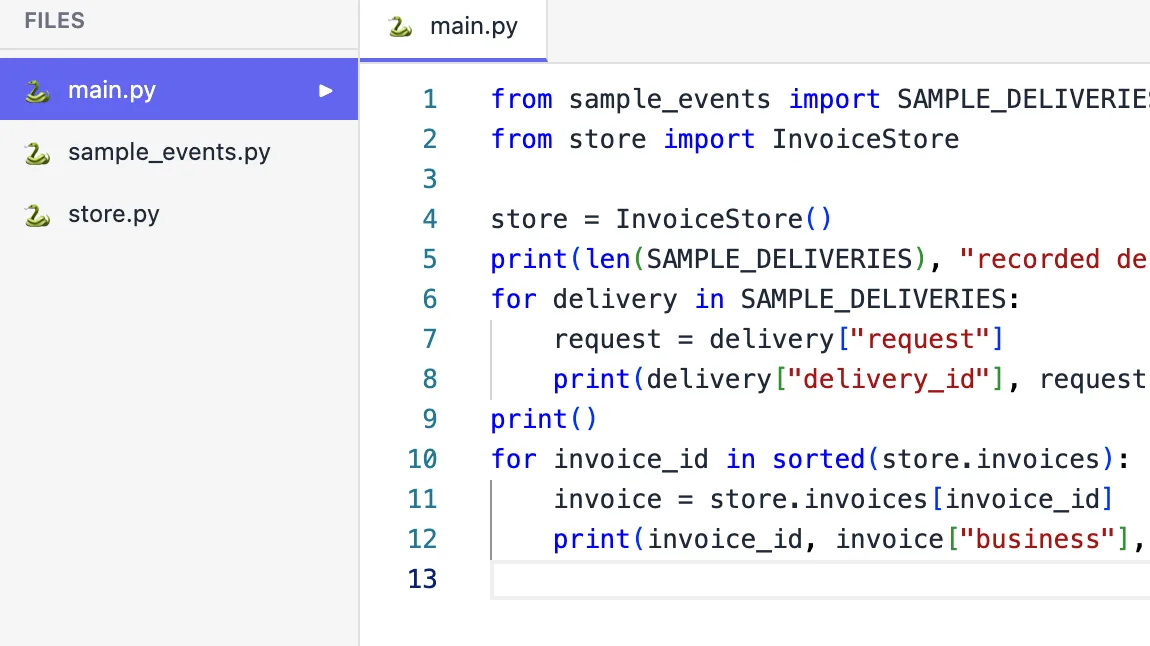
What a strong candidate did: Made the handler safe to receive the same event twice, ignored events that arrive out of order, and showed both reported bugs fixed with tests. The note told billing operations which past invoices to re-check.
A design on a whiteboard, then a written note
Nightly job ingestion from a partner scheduling API
Each night the product pulls changed jobs from a partner scheduling platform into PostgreSQL. At 06:00 a dispatch agent builds every business’s day plan from them, and dispatch teams start at 06:30. Jobs have been missing and duplicated.
What a strong candidate did: Designed an ingest that resumes from where it stopped, updates rather than duplicates, and finishes well before 06:00 with an alert if it will not. Named the one case that still needs a person to look.
How the decision gets made
With Gateway, API developer candidates work through situations written from your job description, for example a webhook handler that records payments twice or a nightly pull from a partner's scheduling API that must finish before the morning. Candidates write code and draw designs, then explain the fix in a note for the team that consumes it. The engineering manager reads a score and written feedback per skill and opens each candidate's code read-only, so the interview can focus on contract decisions the candidate has already made.
See your next API developer at work before you meet them
Paste your job description and Gateway writes the assessment in about 5 to 10 minutes. Your team can edit every question before it goes out.
Questions
Our API developer mostly builds integrations with outside platforms. Can the tasks reflect that?
Yes. Gateway writes the assessment from your job description, so if the role is integration-heavy, the situations are about partner APIs, webhooks and consumer contracts. Your team reads and edits every question before sending.
Can it cover GraphQL or gRPC as well as REST?
The tasks follow the technologies your job description names. If your API surface uses more than one style, say so in the description and edit the questions to match.
What does the hiring manager receive for each candidate?
A score and written feedback for each skill, a tier from 1 to 5, and whether the candidate meets your line, plus read-only access to the code and notes. Results can be shared with a note.
How long does a candidate take, and what is needed?
That depends on the tasks your team keeps. Candidates need a laptop or desktop and one link, and each step says what it involves before the candidate accepts it.
Is there a question bank candidates could find online?
No. Each assessment is written from your own job description, and there is no multiple choice. Optional monitoring, with a replay, is available if your team wants it.
Related