Hire a microservices engineer who designs for the call that fails halfway
A microservices engineer keeps a system of separately deployed services correct when any one of them is slow, down or receiving the same message twice. Box-and-arrow diagrams look similar from every candidate, so the way to tell them apart is to see each one design and fix a real cross-service problem before the platform team runs interviews.
What the hiring manager needs from a microservices engineer
Teams hiring a microservices engineer usually already run many services talking over HTTP, gRPC or a message broker such as Kafka or RabbitMQ. The platform lead needs someone who thinks about timeouts, retries, ordering and ownership at every boundary, because that is where incidents in this architecture start.
A request that fails somewhere in the chain
A user action passes through several services and occasionally ends in an error nobody can place. The engineer follows it with distributed tracing and correlation IDs, finds the service that times out, and fixes the timeout and retry settings that turned one slow call into a cascade.
A consumer that processes the same message twice
The broker guarantees delivery at least once, and a consumer restart means some events are handled again. The engineer makes the consumer idempotent and handles messages that arrive out of order, instead of hoping duplicates are rare.
Data that must stay consistent across services
An order service and an inventory service disagree after a failure in the middle of a workflow. The engineer designs the compensation steps or the outbox pattern that brings them back in line, and decides what the user sees in between.
Carving a service out of the monolith
The business wants one module split out and deployed on its own. The engineer chooses a boundary that matches how the data is owned, plans a migration that runs both paths for a while, and avoids creating two services that must always deploy together.
Where hiring a microservices engineer usually goes wrong
- Hiring the vocabulary
- Service mesh, saga, event sourcing and CQRS are easy to say in an interview. Candidates who have only read about them describe the pattern; candidates who have operated them describe what went wrong and how it was detected.
- Kubernetes experience taken as microservices experience
- Deploying containers is a different skill from designing service boundaries and handling partial failure. A resume heavy in cluster tooling can belong to someone who has never had to reconcile data across services.
- Design rounds with no failure in them
- A whiteboard round where every call succeeds tests drawing. The real test is what the candidate does when a downstream service is slow, a message is duplicated or a deploy is half rolled out.
- Rewarding more services as more skill
- Some candidates split everything. A strong microservices engineer can also explain when a boundary is not worth its network calls, and that judgement rarely shows in a standard interview.
Real tasks from a Gateway assessment
These come from a Gateway assessment for a backend engineer, with the employer’s name taken out. Gateway writes every assessment from your own job description, so the tasks your candidates get are built around your role.
A design on a whiteboard, then a written note
Nightly job ingestion from a partner scheduling API
Each night the product pulls changed jobs from a partner scheduling platform into PostgreSQL. At 06:00 a dispatch agent builds every business’s day plan from them, and dispatch teams start at 06:30. Jobs have been missing and duplicated.
What a strong candidate did: Designed an ingest that resumes from where it stopped, updates rather than duplicates, and finishes well before 06:00 with an alert if it will not. Named the one case that still needs a person to look.
Code, then a short written note
Payment webhook handler for invoice updates
A billing product for home-services businesses learns about each payment from a provider webhook. Some homeowners got two receipts for one payment, and some paid invoices still show as unpaid. The candidate owns the handler.
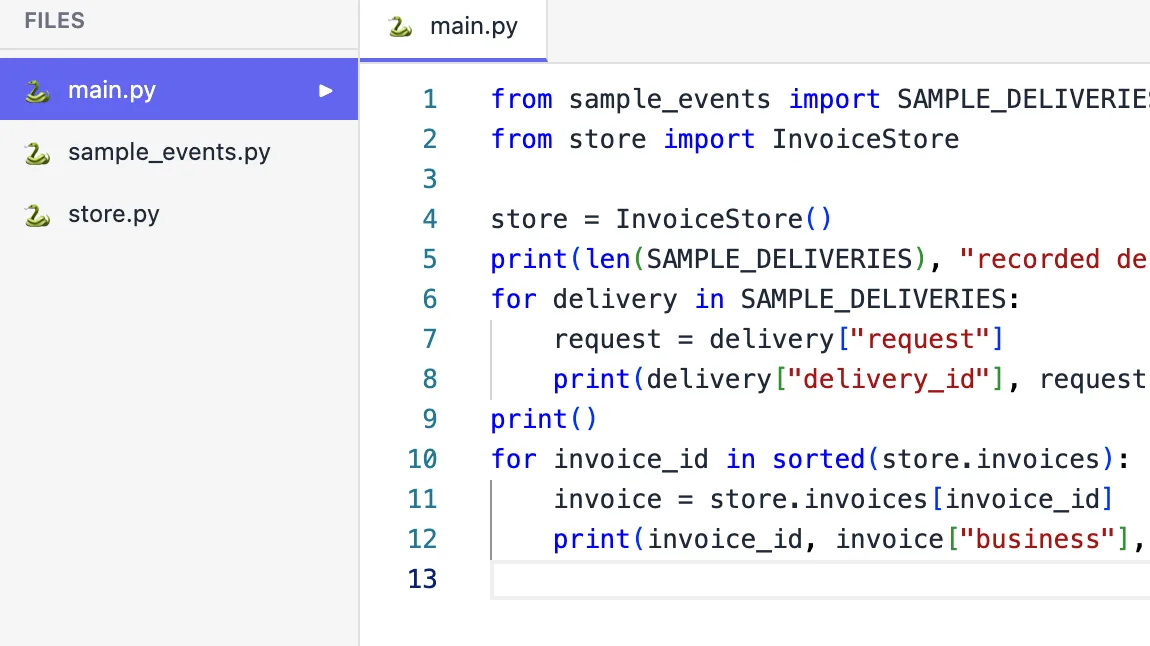
What a strong candidate did: Made the handler safe to receive the same event twice, ignored events that arrive out of order, and showed both reported bugs fixed with tests. The note told billing operations which past invoices to re-check.
How the decision gets made
With Gateway, microservices engineer candidates work through situations written from your job description, such as a partner ingest that must be resumable and idempotent before a morning deadline, or a webhook endpoint that receives retried events out of order. Candidates design on a whiteboard, write code and explain their failure handling in a note. The platform lead reads a score and written feedback for each skill, opens the designs and code read-only, and spends design interviews only on people who already showed they plan for partial failure.
See your next microservices engineer at work before you meet them
Paste your job description and Gateway writes the assessment in about 5 to 10 minutes. Your team can edit every question before it goes out.
Questions
Can the tasks reflect our broker and our service setup?
Yes. Gateway writes the assessment from your job description, so the situations use the messaging, protocols and tooling the role names. Your team can read and edit every question before it goes out.
Can a candidate draw a design, or only write code?
Both. Candidates can work on a whiteboard for service designs, in code for consumers and handlers, and in a written note for trade-offs. Every piece opens read-only for your reviewers.
How does Gateway score a distributed design?
Each skill gets a score and written feedback, so your platform lead can see how the candidate handled retries, ordering and ownership. Your team can change any score and makes the final decision.
Is monitoring required?
No. Monitoring is off by default, with four levels from activity only to camera on and a replay of the test. Gateway never marks a candidate as cheating on its own.
We are hiring for several services teams. Can one assessment serve them all?
Write one from each team's job description so the situations match that team's services, or use one for all. Add candidates from an ATS export, a spreadsheet or resumes, and each gets one link and a deadline.
Related