Hire a compliance engineer who turns audits into routine work
A compliance engineer turns security and privacy requirements into controls that run inside the systems, with evidence gathered automatically instead of a screenshot scramble before each audit. Many applicants know the frameworks and fewer can build the checks, so the way to tell candidates apart is to see each one map real controls and handle a real audit deadline before you interview.
What the hiring manager needs from a compliance engineer
The security or engineering manager hiring a compliance engineer is usually tired of audit season: weeks of screenshots, chasing engineers for evidence, and the same findings coming back each year. The manager needs someone who knows what an auditor will test and can make the platform prove it continuously.
Evidence collected by screenshot
Last year's audit evidence was gathered by hand from cloud consoles and the ticket system. The compliance engineer replaces the screenshots with scripted exports and scheduled checks, so evidence for access reviews, backups and change approval exists before the auditor asks.
One control, three frameworks
SOC 2, ISO 27001 and a customer's contract terms each ask for access reviews in slightly different words. The engineer maps them to one control with one test, so the team runs a single process that answers all three.
An audit date that will not move
A customer renewal depends on a report by a fixed date, and two controls are not working. The engineer says which gaps block the audit and which can stand as documented exceptions, and holds firm when someone suggests describing a control that does not exist.
Developers who see compliance as overhead
Engineers resist a new change-approval step. The compliance engineer builds approval into the pull request and deploy pipeline they already use, so the control costs them a click instead of a meeting.
Where hiring a compliance engineer usually goes wrong
- Hiring an auditor into an engineering seat
- A background in audit brings strong knowledge of control language. If the candidate cannot write the script or pipeline check that produces the evidence, the team ends up with better policies and the same manual scramble.
- Hiring an engineer with no audit sense
- The opposite miss: a capable developer who automates checks no auditor will accept, or misreads what a Type II observation period requires. The role needs both halves, and most interview loops test only one.
- Asking candidates to recite control lists
- Knowing that a framework has a change-management clause is easy to check and of little use. What matters is how the candidate would prove that every production change was approved, from the systems you actually run.
- Ignoring pressure to cut corners
- Near an audit deadline, someone senior will ask whether a gap can be papered over. A compliance engineer who agrees creates a bigger problem at the next audit or in a customer dispute.
Real tasks from a Gateway assessment
These come from a Gateway assessment for a cybersecurity analyst, with the employer’s name taken out. Gateway writes every assessment from your own job description, so the tasks your candidates get are built around your role.
A spreadsheet and a chat with the CFO
Audit window decision across ISO 27001, SOC 2 and GDPR
A customer renewal requires a SOC 2 Type II report by a fixed date, and the CFO wants the audit to start on time. Some controls are not ready.
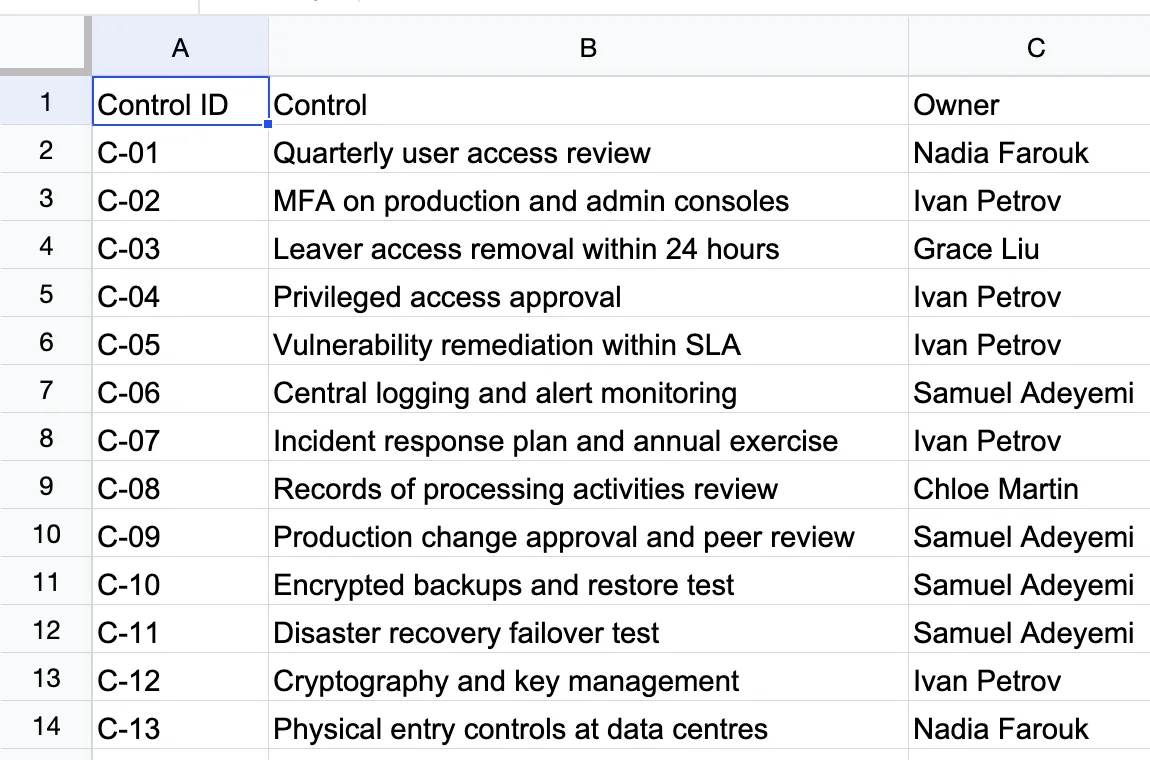
What a strong candidate did: Showed which gaps block the audit and which do not, proposed a start date that still meets the renewal, and held the line on the controls that cannot be skipped.
A spreadsheet, then a written recommendation
Vulnerability triage under a payments change freeze
A penetration test and weekly scans have been merged into one list of open findings. Payments systems are under a change freeze, and the CISO must sign a remediation recommendation before the next change board.
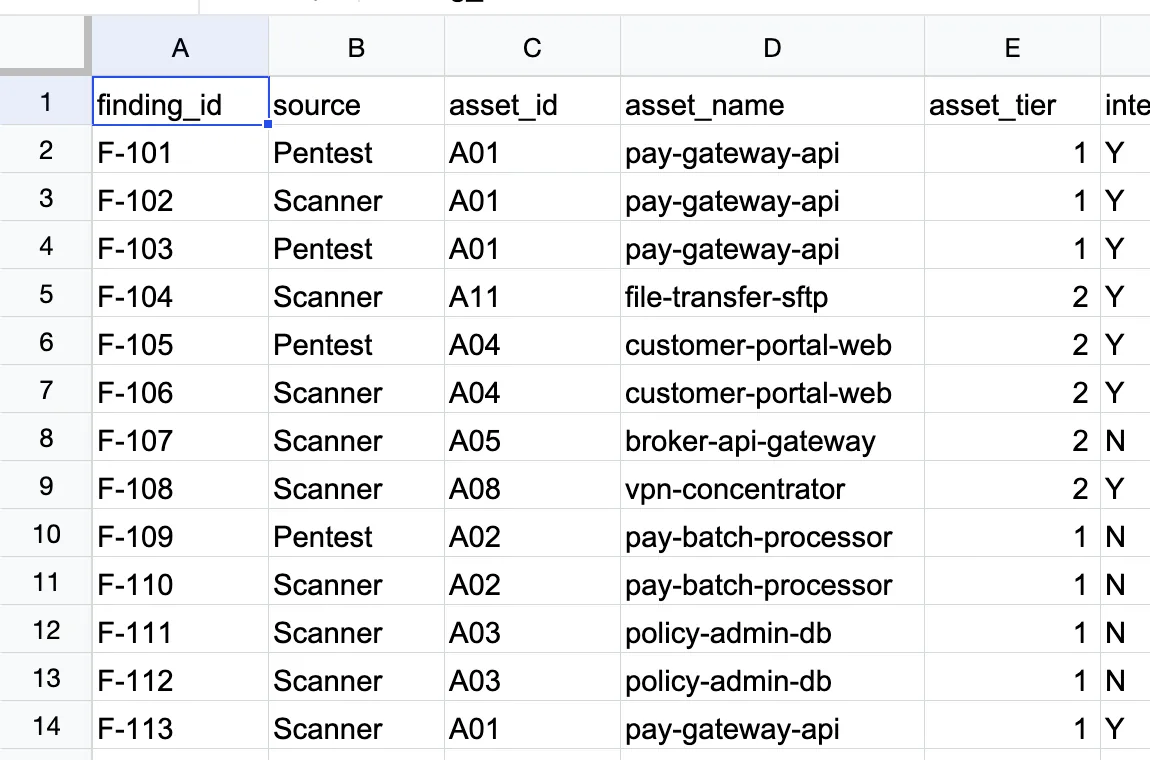
What a strong candidate did: Ranked findings by real exposure rather than scanner score, named the few that justify an exception to the freeze, and wrote the recommendation the CISO could sign.
How the decision gets made
In Gateway, each compliance engineer candidate works through situations built from your job description: an audit window across ISO 27001, SOC 2 and GDPR where some controls are not ready and the CFO wants a start date, and a findings list to rank under a change freeze. The candidate works in a spreadsheet and a chat with an AI CFO, and in code where your role calls for automation. The hiring manager sees each skill scored with its reasoning, reads exactly where the candidate held the line, and interviews only the people who combined control knowledge with engineering judgement.
See your next compliance engineer at work before you meet them
Paste your job description and Gateway writes the assessment in about 5 to 10 minutes. Your team can edit every question before it goes out.
Questions
Can the assessment include writing automation, beyond mapping controls?
Yes. If your job description asks for scripting or pipeline work, the assessment can include it, since candidates can work in code alongside a spreadsheet. Your team edits every task before it goes out.
Our frameworks differ from the examples. Is that a problem?
No. The situations follow the frameworks named in your job description, whether that is SOC 2, ISO 27001, PCI DSS, HIPAA or a regional privacy law.
Who decides whether a candidate passes?
Your team. Gateway gives a score and written feedback for each skill, a tier from 1 to 5 and whether the candidate meets your line, and anyone on your team can change a score.
How do candidates know what they are signing up for?
Each step explains what it involves before the candidate accepts it. Candidates need a laptop or desktop and the one link you send, with a deadline you choose.
Related