Hire a game developer who keeps the game smooth while the design keeps moving
A game developer turns design ideas into systems that run inside a fixed frame budget on every target platform, while designers keep changing what they want. Demo reels and credits hide who did what, so the way to compare candidates is to see each one work through real gameplay and engine situations before your team books interviews.
What the hiring manager needs from a game developer
Studios hiring a game developer without naming an engine often run their own C++ engine, or need someone who moves between gameplay code, tools and performance work. The technical director or lead programmer needs a developer who writes systems designers can tune without a programmer, and who notices when a feature costs more of the frame than it should.
A feature that blows the frame budget
A new crowd system looks great in the editor and drops frames on the lowest target hardware. A strong game developer profiles before changing anything, finds the per-frame allocations or the update that runs on every entity, and cuts the cost without cutting the feature.
A save system that corrupts on update
Players lose progress after a patch because the save format changed. The developer versions the save data, writes a migration from old saves, and makes sure a crash mid-write does not destroy the previous file.
Gameplay that designers need to tune
Every change to jump height or enemy health needs a programmer and a rebuild. The developer moves those values into data that designers can edit live, with sensible limits so a typo does not break a level.
Players who see different things in multiplayer
Two players disagree on whether a hit landed. The developer understands client prediction, server authority and lag compensation well enough to find which side is wrong and fix it without opening the game to cheating.
Where hiring a game developer usually goes wrong
- Judging by the shipped-titles list
- A credit on a large game can mean a small part of a large team's work. It does not show whether the candidate can own a system, or only change one under close supervision.
- Algorithm puzzles instead of game problems
- Generic coding rounds measure something real, but not frame-time thinking, memory layout or how state moves across a network. A candidate can pass the puzzle and still write a gameplay system that stutters.
- Not checking how the candidate works with design
- Game code changes constantly as designers iterate. A developer who builds rigid systems, or resists every tuning request, slows the whole team more than a slower coder would.
Real tasks from a Gateway assessment
These come from a Gateway assessment for a C++ developer, with the employer’s name taken out. Gateway writes every assessment from your own job description, so the tasks your candidates get are built around your role.
C++, then a short note
Radar track store: ownership and templates
The flight software lead asks for the in-memory list of radar tracks that the display and cueing logic read. Three kinds of track rank themselves differently, and the lead will review the change.
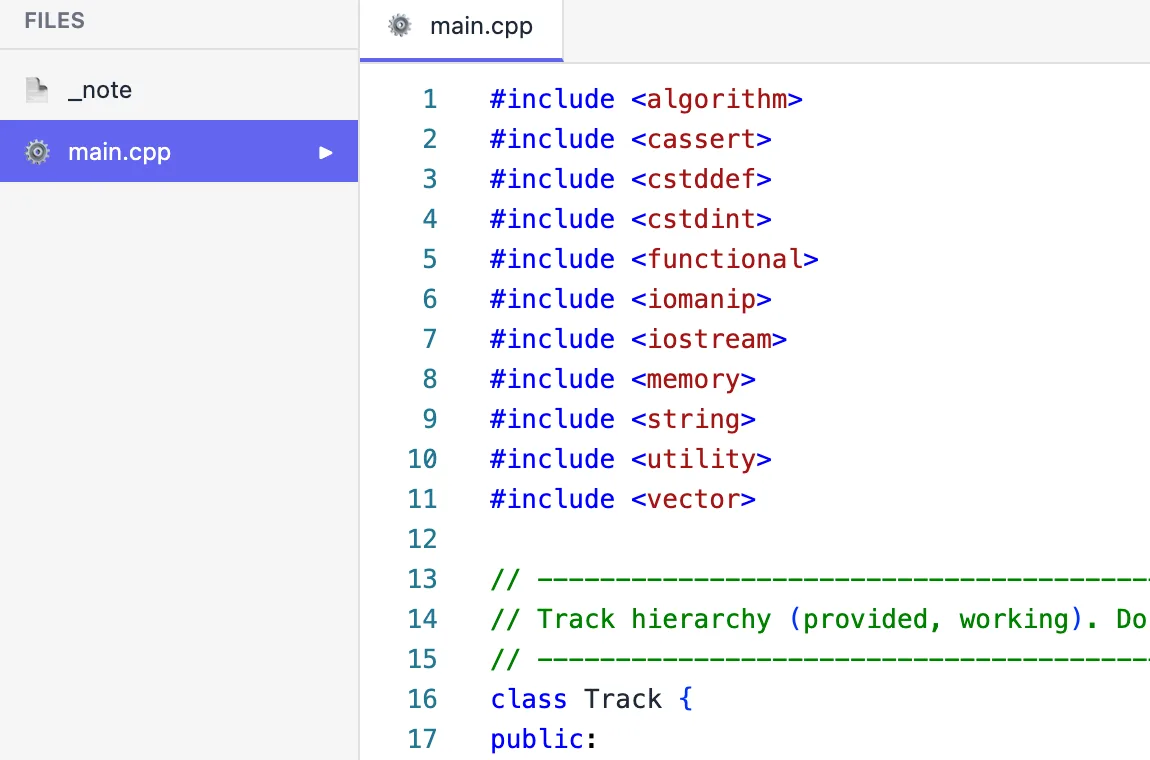
What a strong candidate did: Gave the store clear ownership of its tracks, kept ranking inside each track type, and made the reads safe for the display while tracks are added.
C++, then a short note
Telemetry queue: fix the race and prove it
On an unmanned aircraft, a sensor thread fills a bounded queue and a link thread sends frames over the radio. Telemetry freezes now and then in the field, and nobody can reproduce it on demand.
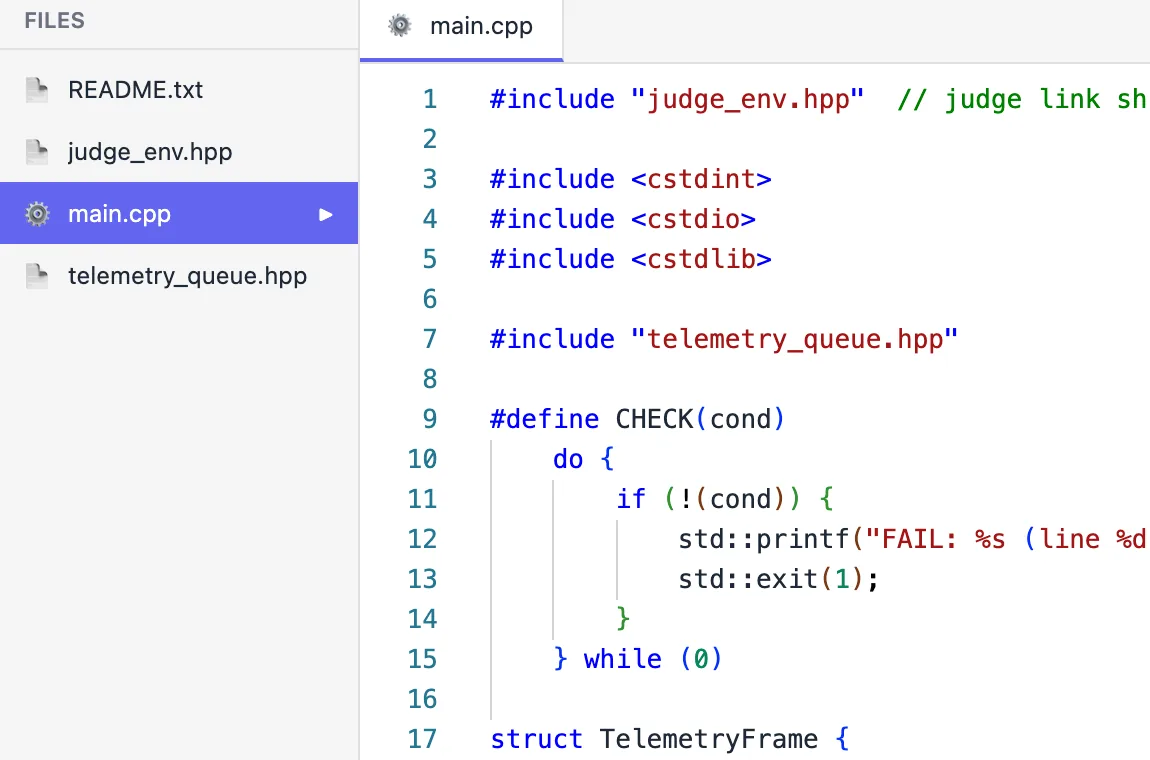
What a strong candidate did: Found the race in the queue, fixed it without adding latency, and wrote a stress test that fails reliably on the old code and passes on the new.
How the decision gets made
With Gateway, each game developer candidate works through situations written from your job description, for example a system that exceeds the frame budget, a save format to migrate or a race between threads, in C++ or the language your engine uses, with a short note or recorded walkthrough on the trade-offs. Your lead programmer sees a score and written feedback for each skill, opens the code read-only, and meets only the developers who think about cost and data the way your game needs.
See your next game developer at work before you meet them
Paste your job description and Gateway writes the assessment in about 5 to 10 minutes. Your team can edit every question before it goes out.
Questions
The sample tasks on this page are not about games. Will ours be?
Yes. The samples come from a C++ assessment for another kind of real-time software. Gateway writes yours from your job description, so the gameplay, engine and performance situations follow your game, and your team can edit every question.
Our engine is custom. Can the assessment work without a commercial engine?
Yes. Candidates work in code, a whiteboard design or a recorded walkthrough, so the tasks can be built around your own engine's patterns in C++.
Can designers or producers see the results too?
Results can be shared with a note. Each skill has a score and written feedback, and any candidate's work opens read-only for whoever reviews it.
Can candidates use AI tools?
Only in an AI-assisted assessment, which you choose. Your team then sees how each candidate worked with the assistant.
How long does it take to set one up for our studio?
About 5 to 10 minutes from your job description. Your lead programmer reads and edits each task, for example to name your engine, target platforms or networking model, before any candidate receives a link.
Related