Hire a Solidity developer who writes EVM code that is cheap to run and hard to break
A Solidity developer is hired for depth in one language and one machine: storage layout, gas cost, the ERC standards, and testing tools such as Foundry and Hardhat. Plenty of people can write a contract that compiles, so the useful question is how a candidate changes real Solidity under constraints, and you can see that before an interview if you ask for the work.
What the hiring manager needs from a Solidity developer
When a posting names Solidity, the team usually already has contracts in production and wants someone who can extend them without raising gas costs or opening a hole. The tech lead needs fluency with the EVM itself: why a storage write costs what it does, what a compiler version changes, and how inherited OpenZeppelin code behaves once a function is overridden.
A function that runs out of gas as usage grows
A loop over an array of holders worked at launch and now fails because the array is long. The developer should redesign it, perhaps with pull-based claims or pagination, instead of raising the gas limit and hoping.
Packing storage in a live contract's successor
Users complain about fees on a frequently called function. The developer reads the storage layout, packs variables that are written together, removes redundant reads, and proves with gas snapshots that each change saved what it claims.
Implementing a standard to the letter
The product needs an ERC-4626 vault or an ERC-20 with permit. Each standard has rounding rules, events and edge cases that other contracts and wallets rely on, and a near-miss implementation breaks integrations without any error.
Fuzzing before a release
The lead expects Foundry tests that throw random inputs at the contract and check invariants, such as total shares never exceeding assets. A Solidity developer who writes these unprompted catches bugs no reviewer would see by reading.
Where hiring a Solidity developer usually goes wrong
- Quiz questions about syntax
- Asking what view or payable means confirms the candidate has read the documentation. It does not show whether the person knows when an unchecked block is safe, or what a delegatecall into the wrong contract does to storage.
- Gas golf with no context
- Some candidates show off assembly tricks that shave a little gas and make the code unreadable. For most teams, Solidity a reviewer can verify matters more than the last few units of gas.
- Overlooking inherited code
- Real Solidity sits on libraries. Candidates who cannot follow which parent contract's function actually runs after an override will introduce bugs in code they never touched.
- Treating Hardhat and Foundry as boxes to tick
- Listing both on a resume is common. Whether the candidate writes meaningful assertions and fork tests against mainnet state is what tells you something.
Real tasks from a Gateway assessment
These come from a Gateway assessment for a backend engineer, with the employer’s name taken out. Gateway writes every assessment from your own job description, so the tasks your candidates get are built around your role.
A design on a whiteboard, then a written note
Nightly job ingestion from a partner scheduling API
Each night the product pulls changed jobs from a partner scheduling platform into PostgreSQL. At 06:00 a dispatch agent builds every business’s day plan from them, and dispatch teams start at 06:30. Jobs have been missing and duplicated.
What a strong candidate did: Designed an ingest that resumes from where it stopped, updates rather than duplicates, and finishes well before 06:00 with an alert if it will not. Named the one case that still needs a person to look.
Code, then a short written note
Payment webhook handler for invoice updates
A billing product for home-services businesses learns about each payment from a provider webhook. Some homeowners got two receipts for one payment, and some paid invoices still show as unpaid. The candidate owns the handler.
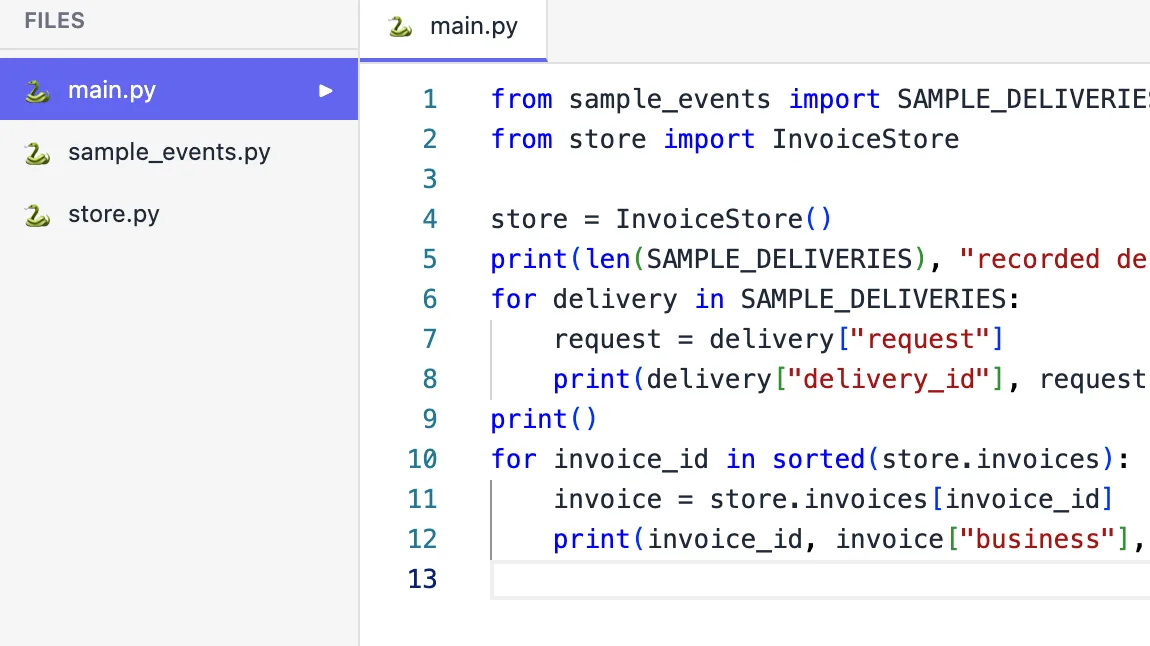
What a strong candidate did: Made the handler safe to receive the same event twice, ignored events that arrive out of order, and showed both reported bugs fixed with tests. The note told billing operations which past invoices to re-check.
How the decision gets made
With Gateway, each Solidity developer candidate works through situations drawn from your job description in a code editor, then finishes with a short note on what changed and why. The tasks shown below come from real backend assessments; for a Solidity role they are written around your contracts, standards and tooling instead. Your tech lead sees every skill scored with its reason and the full code read-only, so the people who reach the interview are the ones whose Solidity already reads like your team's.
See your next Solidity developer at work before you meet them
Paste your job description and Gateway writes the assessment in about 5 to 10 minutes. Your team can edit every question before it goes out.
Questions
Can the tasks start from our existing contracts?
The assessment is written from your job description, and your team can edit any question, so you can paste in a simplified version of your own contract for candidates to extend or review.
Does Gateway check gas use or only correctness?
Whatever your job description stresses becomes a skill in the assessment. If gas efficiency matters to the role, it is scored with written feedback alongside correctness and test quality.
Will candidates find the Solidity questions online?
There is no question bank to find. Each assessment is generated from your role, and there are no multiple choice answers to memorise.
How many candidates can we send it to?
As many as you add. Import them from an ATS export, a spreadsheet or resumes, and each one receives a single link and a deadline.
Can our Solidity lead override a score?
Yes. Every score can be changed by your team, and the final decision always rests with the people hiring.
Related