Hire an Unreal developer who knows when to write C++ and when to leave it in Blueprints
An Unreal developer works across the engine's C++ and Blueprints, building gameplay systems that replicate correctly, respect Unreal's object lifecycle and package cleanly for every platform. Experience with the editor is common and experience with the C++ underneath is not, so the way to compare candidates is to see each one work on real Unreal situations before your team books interviews.
What the hiring manager needs from an Unreal developer
Game studios, and teams in virtual production, architecture and simulation, hire Unreal developers to turn designers' Blueprint prototypes into systems that hold up in a shipped build. The lead programmer needs someone who understands the game thread, replication and Unreal's garbage collector, and who leaves designers with Blueprint hooks they can still work with.
A Blueprint prototype that has become too slow
A designer's Blueprint ticks every frame on hundreds of actors and the game thread is over budget. A strong Unreal developer measures it in Unreal Insights, moves the hot logic into C++, and exposes clean functions and events so the designer keeps control of the behaviour.
A pointer the garbage collector freed
A crash appears after level transitions because a raw pointer to a UObject was never marked as a UPROPERTY. The developer understands what the garbage collector tracks, uses the right pointer types and fixes the ownership rather than adding null checks everywhere.
Multiplayer state that disagrees between clients
An ability shows as used on one client and ready on another. The developer checks authority, replicated properties and RPC reliability, and fixes it inside the Gameplay Ability System or the team's own framework without flooding the network.
A packaged build that stutters or fails to cook
The game runs in the editor, but the packaged build hitches the first time each effect appears, or cooking fails on a missing reference. The developer tracks down shader compilation stutter and broken asset references and gets a clean, smooth build out.
Where hiring an Unreal developer usually goes wrong
- Hiring on Blueprint portfolios for a C++ role
- Impressive Blueprint projects show design sense and engine familiarity. If the role needs engine-level C++, replication code or plugin work, you need to see the candidate write it.
- Testing standard C++ and calling it Unreal
- Unreal's C++ has its own macros, reflection, memory rules and containers. A candidate strong in standard C++ can still misuse UObjects and introduce crashes that appear only after a garbage collection pass.
- Leaving out replication
- Single-player demos dominate reels. If your project is multiplayer, a candidate who has never owned replicated gameplay will need close supervision on exactly the code that is hardest to debug.
Real tasks from a Gateway assessment
These come from a Gateway assessment for a C++ developer, with the employer’s name taken out. Gateway writes every assessment from your own job description, so the tasks your candidates get are built around your role.
C++, then a short note
Telemetry queue: fix the race and prove it
On an unmanned aircraft, a sensor thread fills a bounded queue and a link thread sends frames over the radio. Telemetry freezes now and then in the field, and nobody can reproduce it on demand.
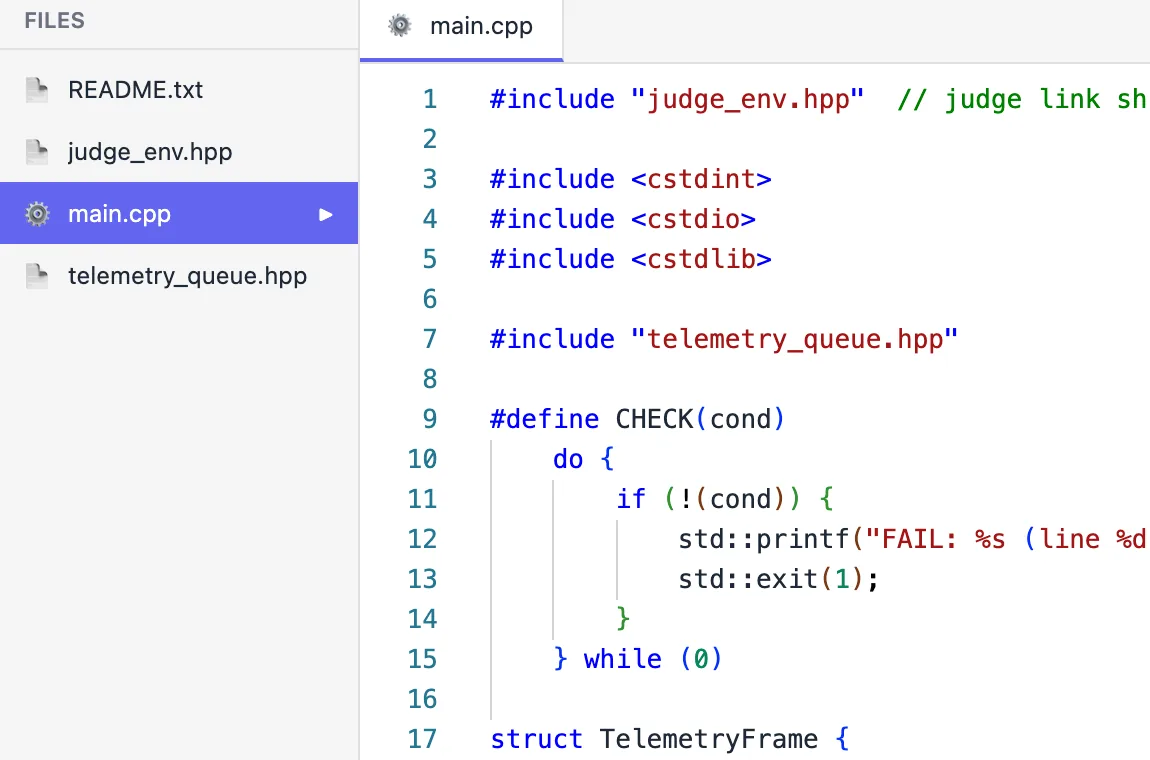
What a strong candidate did: Found the race in the queue, fixed it without adding latency, and wrote a stress test that fails reliably on the old code and passes on the new.
C++, then a short note
Radar track store: ownership and templates
The flight software lead asks for the in-memory list of radar tracks that the display and cueing logic read. Three kinds of track rank themselves differently, and the lead will review the change.
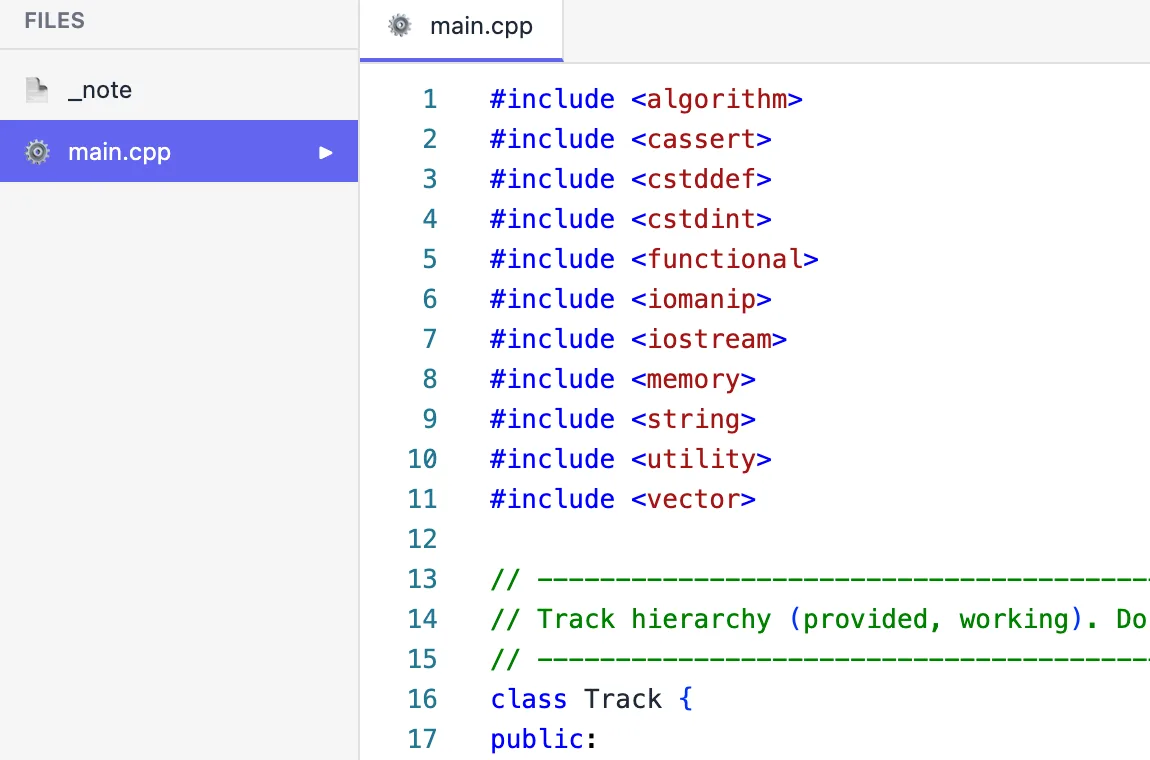
What a strong candidate did: Gave the store clear ownership of its tracks, kept ranking inside each track type, and made the reads safe for the display while tracks are added.
A spreadsheet, then a written recommendation
Payload sensor selection from a data sheet extract
A hardware engineer sends vendor data sheet extracts for candidate sensors and needs a recommendation within the payload power budget. The candidate will write the drivers for whatever is chosen.
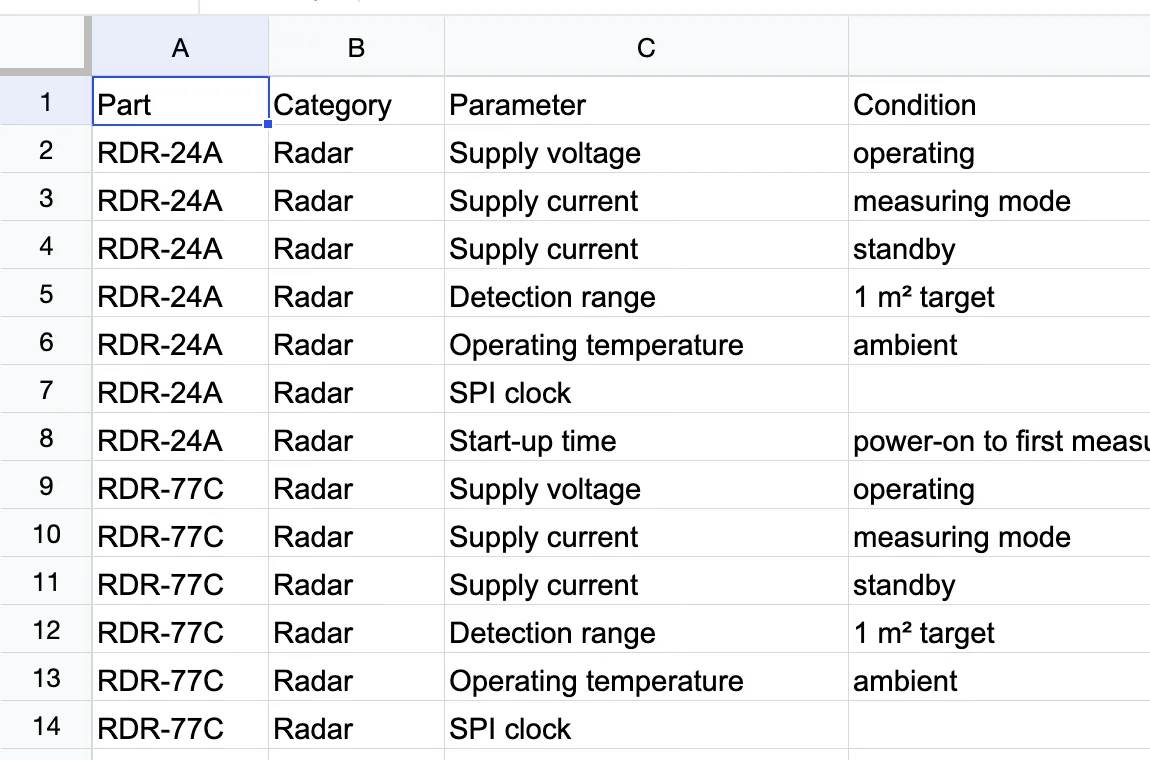
What a strong candidate did: Picked parts that fit the power budget with margin, flagged the one data sheet figure that did not add up, and listed what the drivers must handle for each part.
How the decision gets made
With Gateway, each Unreal developer candidate works through situations written from your job description, such as hot Blueprint logic to move into C++, ownership that crashes after a level change or a race between threads, in C++ code with a short note or recorded walkthrough on the Blueprint side. Your lead programmer sees a score and written feedback for each skill, opens the code read-only, and meets only the developers who respect how Unreal manages memory, threads and the network.
See your next Unreal developer at work before you meet them
Paste your job description and Gateway writes the assessment in about 5 to 10 minutes. Your team can edit every question before it goes out.
Questions
The sample tasks are not about Unreal. Will ours be?
Yes. The samples come from a C++ assessment for real-time flight software. Gateway writes your assessment from your job description, so it centres on Unreal situations, and your team can edit every question.
Can candidates show Blueprint skills?
Candidates work in code, a whiteboard or a recorded walkthrough rather than inside the editor. A whiteboard or walkthrough task lets a candidate lay out a Blueprint graph or explain where logic belongs.
We are not a games studio. Does this fit virtual production or simulation roles?
Yes. The situations come from your job description, so a virtual production or simulation role gets tasks from that work.
How do we see whether a candidate meets our standard?
Each skill is scored with written feedback and a tier from 1 to 5, and you see whether the candidate meets your line. Your team can change any score and makes the decision.
Is the test proctored?
Only if you choose. Monitoring is off by default, with four levels from activity only to camera on, and a replay of the test. Gateway never marks a candidate as cheating on its own.
Related