Hire a smart contract developer you would trust with code that holds user funds
A smart contract developer writes code that holds money and usually cannot be changed once deployed, so the role is judged on what does not go wrong: access control, upgrade safety, and tests that cover the attacks before an auditor finds them. The dependable way to separate candidates is to see each one secure and test a real contract change before anyone spends interview time.
What the hiring manager needs from a smart contract developer
Whatever the chain or language, Solidity, Vyper, Rust or Move, the hiring manager for this role is buying caution. Contract bugs are public, exploitable within minutes and often permanent. The person you hire has to think like an attacker, write tests that prove the invariants, and still ship the features the product team asked for.
A vault going to audit next month
A new deposit contract is nearly done and the audit is booked. The developer should find the obvious issues first so the audit budget goes on the subtle ones: rounding that favours the depositor, missing checks on who can withdraw, and external calls made before state is updated.
An upgrade to a contract already holding value
The protocol uses a proxy and needs a new function. A careful developer checks the storage layout so nothing is overwritten, routes the upgrade through the multisig or timelock, and writes down how to roll forward if it misbehaves, since rolling back may be impossible.
An oracle price the contract relies on
Liquidations or mint prices depend on an external price feed. The developer should ask what happens if the feed is stale, paused or briefly manipulated within a single block, and design limits instead of trusting the number.
Answering the auditor's report
Findings come back ranked by severity. The developer fixes what matters, argues clearly where a finding does not apply, and adds tests that prove each fix, instead of quietly disabling a feature to make an issue disappear.
Where hiring a smart contract developer usually goes wrong
- Counting deployed contracts
- A long list of contract addresses shows that code reached mainnet, not that it was safe. Plenty of deployed code was copied from templates, and some of it was drained later.
- Treating an audited project as proof of skill
- Having worked on a project that passed an audit tells you auditors were hired. It does not show whether the candidate wrote the code that passed or the code the auditors had to flag.
- Interviews that only check language knowledge
- Reciting how modifiers or fallback functions work is expected of every applicant. What separates candidates is whether the person notices that a function lets anyone empty the contract when called in an unusual order.
- No look at how the candidate tests
- A contract without property or fuzz tests relies on a reviewer's eyes. Candidates who write only happy-path unit tests leave your auditors, or an attacker, to find the rest.
Real tasks from a Gateway assessment
These come from a Gateway assessment for a backend engineer, with the employer’s name taken out. Gateway writes every assessment from your own job description, so the tasks your candidates get are built around your role.
Code, then a short written note
Payment webhook handler for invoice updates
A billing product for home-services businesses learns about each payment from a provider webhook. Some homeowners got two receipts for one payment, and some paid invoices still show as unpaid. The candidate owns the handler.
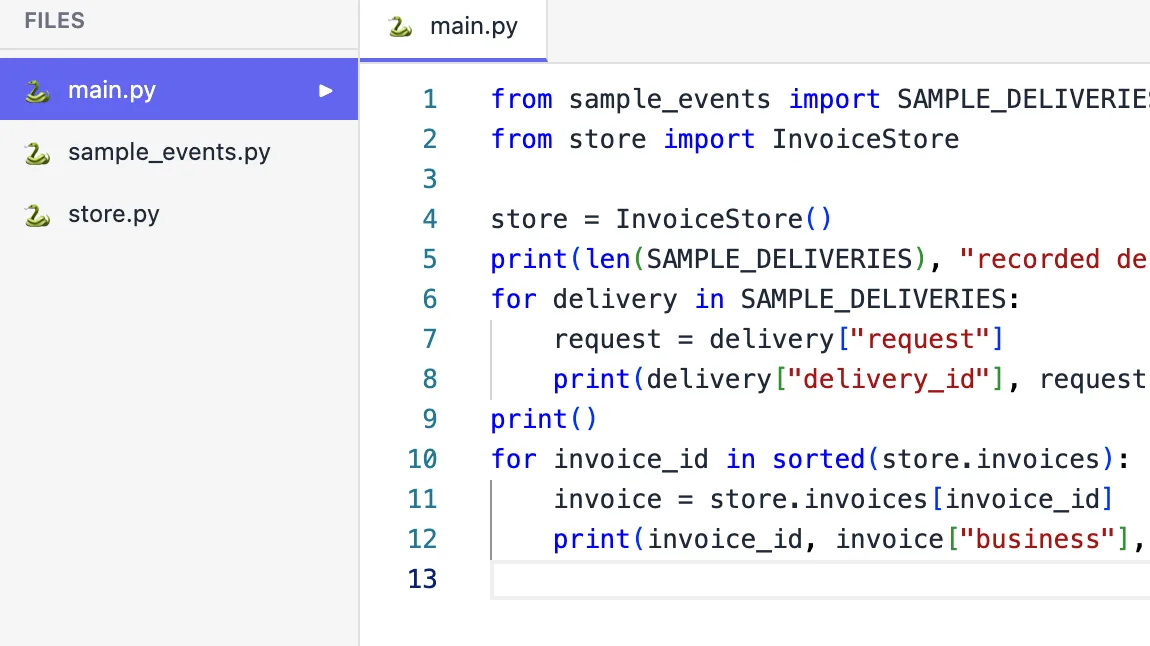
What a strong candidate did: Made the handler safe to receive the same event twice, ignored events that arrive out of order, and showed both reported bugs fixed with tests. The note told billing operations which past invoices to re-check.
A design on a whiteboard, then a written note
Nightly job ingestion from a partner scheduling API
Each night the product pulls changed jobs from a partner scheduling platform into PostgreSQL. At 06:00 a dispatch agent builds every business’s day plan from them, and dispatch teams start at 06:30. Jobs have been missing and duplicated.
What a strong candidate did: Designed an ingest that resumes from where it stopped, updates rather than duplicates, and finishes well before 06:00 with an alert if it will not. Named the one case that still needs a person to look.
How the decision gets made
With Gateway, smart contract developer candidates get situations written from your job description, such as making a payment or deposit handler safe when the same event arrives twice, and work in code with a short written note on the risks still open. Your hiring manager sees each skill scored with the reason, opens the candidate's contract and tests read-only, and meets only the developers who closed the holes before being asked to. The interview then becomes a security review of decisions already on the page.
See your next smart contract developer at work before you meet them
Paste your job description and Gateway writes the assessment in about 5 to 10 minutes. Your team can edit every question before it goes out.
Questions
Can the assessment be in Rust or Move instead of Solidity?
The tasks follow your job description, so they use whichever language and framework the role names. Your team can edit any question, including the starter code, before it is sent.
Can we include an audit-style review task?
Yes. Ask for a task where the candidate reads existing contract code and writes up findings in a document. You see the findings and how the candidate ranked them by severity.
Should candidates be allowed AI help on contract code?
You decide per assessment. In an AI-assisted assessment the candidate may use an assistant and your team sees how it was used, which matters if your developers already review AI-suggested code as part of the work.
How long does setup take for this role?
Roughly 5 to 10 minutes from pasting the job description to having a link you can send, including time to read the tasks and adjust them.
Does a strong score mean we can skip the external audit?
No. The assessment tells you which candidates write and test contracts carefully. Contracts that will hold user funds still need review by people outside the team.
Related