Hire a Unity developer whose C# runs smoothly on the devices your players own
A Unity developer is hired to build gameplay and tools in C# inside Unity, and to keep the result running smoothly on the platforms you ship to, often phones. Candidates all list Unity and C#, so the way to tell them apart is to see each one work on real Unity situations, such as a garbage collection spike or a messy prefab setup, before anyone schedules an interview.
What the hiring manager needs from a Unity developer
Unity is used for mobile games, AR and VR, simulations and training apps, so a Unity developer may be your main programmer or one of several. The lead needs someone who knows the engine's lifecycle and memory model, structures a project that designers and artists can work in, and gets builds out for each platform without a week of surprises.
Stutters from garbage collection
The game hitches every few seconds on Android. A strong Unity developer opens the Profiler, finds allocations in Update from string building, LINQ or new lists, then pools objects and caches components so the collector stops interrupting play.
A project that designers cannot work in
Enemy stats live in code and every level change needs a programmer. The developer moves tuning data to ScriptableObjects, builds prefab variants and adds simple editor tools so designers change the game without touching scripts.
Download size and load times out of hand
The app is too large for some players to install, and every scene loads everything. The developer moves content to Addressables, loads and releases assets on demand, and checks memory after scene changes so nothing leaks.
A build that works in the editor and fails on device
An IL2CPP build strips code that reflection needs, or a plugin breaks on iOS only. The developer reads the build logs, adds the right link settings, and tests on device instead of trusting Play mode.
Where hiring a Unity developer usually goes wrong
- Hiring on a portfolio of Asset Store projects
- Many Unity portfolios are built from purchased assets and templates. They look finished, but they do not show whether the candidate can structure systems or fix performance in someone else's project.
- Testing C# without Unity's rules
- A strong C# developer from business software can still write a Unity game that allocates every frame, misuses FixedUpdate or holds references that keep whole scenes in memory. The engine changes what good code looks like.
- Never discussing target hardware
- A game that runs well on the interviewer's laptop can fail on the phones most players use. If the candidate never mentions profiling on device, that is the conversation to have before hiring, not after launch.
Real tasks from a Gateway assessment
These come from a Gateway assessment for a C++ developer, with the employer’s name taken out. Gateway writes every assessment from your own job description, so the tasks your candidates get are built around your role.
C++, then a short note
Telemetry queue: fix the race and prove it
On an unmanned aircraft, a sensor thread fills a bounded queue and a link thread sends frames over the radio. Telemetry freezes now and then in the field, and nobody can reproduce it on demand.
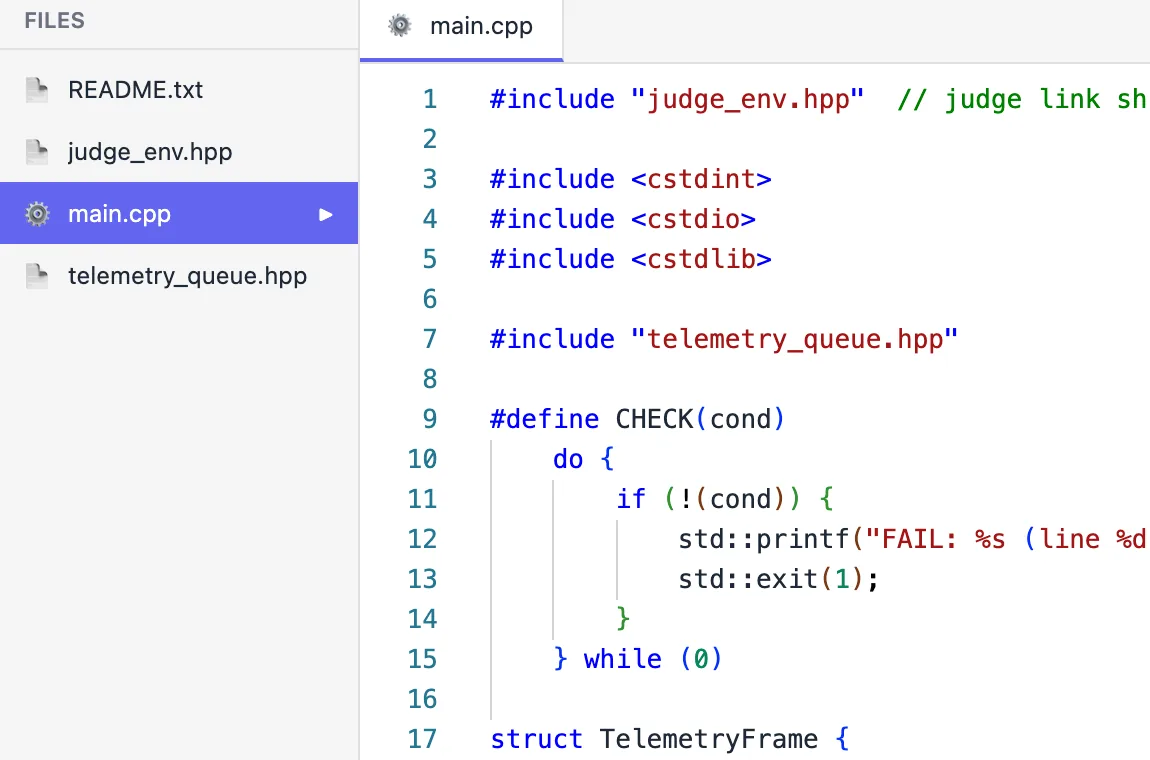
What a strong candidate did: Found the race in the queue, fixed it without adding latency, and wrote a stress test that fails reliably on the old code and passes on the new.
C++, then a short note
Radar track store: ownership and templates
The flight software lead asks for the in-memory list of radar tracks that the display and cueing logic read. Three kinds of track rank themselves differently, and the lead will review the change.
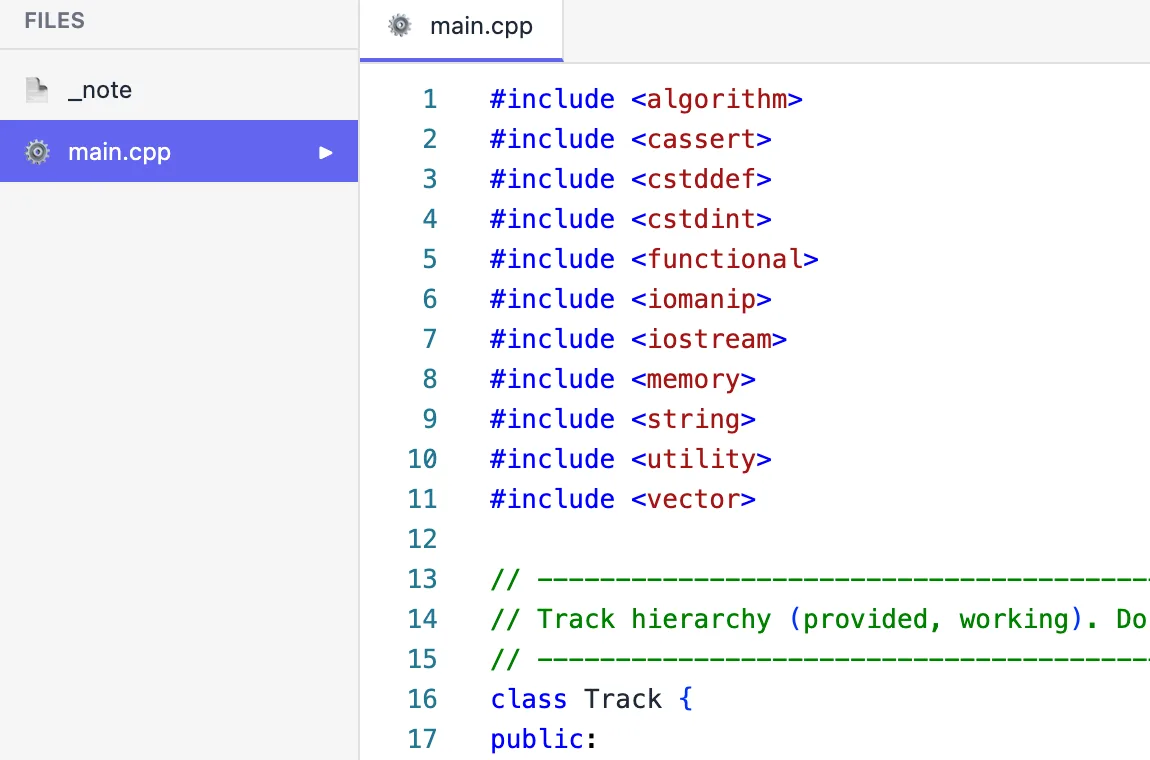
What a strong candidate did: Gave the store clear ownership of its tracks, kept ranking inside each track type, and made the reads safe for the display while tracks are added.
How the decision gets made
With Gateway, each Unity developer candidate works through situations written from your job description, such as allocations to remove from a hot path, tuning data to move into ScriptableObjects or ownership problems in a shared system, in C# code with a short note or recorded walkthrough of the reasoning. Your lead sees each skill scored with written feedback, opens the code read-only, and invites only the developers who build for the devices your players actually hold.
See your next Unity developer at work before you meet them
Paste your job description and Gateway writes the assessment in about 5 to 10 minutes. Your team can edit every question before it goes out.
Questions
The sample tasks are in C++. Will our Unity tasks be in C#?
Yes. The samples here come from a C++ assessment for real-time software. Gateway writes your assessment from your job description, so a Unity role gets C# situations around your game, and your team can edit any question.
Does the assessment run inside the Unity editor?
No. Candidates work in code, a whiteboard, a document or a recorded walkthrough. The tasks focus on the C# and the decisions, and a walkthrough lets a candidate explain how a scene or prefab would be set up.
We build AR and training apps, not games. Does this fit?
Yes. The tasks come from your job description, so an AR or simulation role gets situations from that kind of work.
How quickly can we invite candidates?
Gateway drafts the assessment in about 5 to 10 minutes. After your review, add candidates from a spreadsheet, resumes or an ATS export, and each gets one link and a deadline.
Related