Hire a Java developer who can keep a live service running
A Java developer is worth the seat when the services the developer touches stay correct under load, survive a version upgrade and can be changed by the next engineer without fear. Years of Java on a resume say little about that, so the way to separate candidates is to see each one work on a real backend problem before your senior engineers give up an hour to interview.
What the hiring manager needs from a Java developer
Most teams hiring a Java developer already run a large codebase: a monolith that has grown for years, a set of services around it, and a build that only a few people fully understand. The engineering manager needs someone who can work safely inside that code on day one, not someone who would prefer to rewrite it.
A service that slows down every afternoon
Latency climbs as traffic peaks, and a restart makes it go away until the next day. A capable Java developer reads the heap and thread dumps, separates a connection pool that runs dry from a garbage collector working too hard, and fixes the cause instead of raising the memory limit again.
Two requests that update the same record
An order total is sometimes wrong when two updates land together. The developer has to see the race, choose between a lock, an optimistic version check or an idempotent write, and prove the fix with a test that failed before.
An upgrade nobody wants to start
The service still runs on Java 8, and a library it depends on has stopped shipping fixes. Moving it forward means untangling Maven or Gradle dependency conflicts and removed APIs, one module at a time, without freezing feature work for a quarter.
Code that other teams call
Other services depend on this one's API and its events. Changing a field, a status or a retry rule without breaking a consumer is ordinary work for a Java developer in a large system, and it is where careless hires cause outages in someone else's service.
Where hiring a Java developer usually goes wrong
- Counting years of Java
- Ten years of Java can mean ten years of building new CRUD endpoints on the same framework. It does not tell you whether the candidate has ever traced a memory leak or reasoned about what happens when two threads touch one object.
- Language trivia rounds
- Questions about the difference between an abstract class and an interface, or what the String pool is, reward memorised answers. A strong engineer may answer them slowly, and a weak one who prepared from a list will answer them perfectly.
- Greenfield take-homes
- A small new Spring Boot project built at home shows that the candidate can follow a tutorial structure. The real role is mostly changing old code safely, and a blank project never tests that.
- Ignoring the written explanation
- Java teams work through code review and incident notes. A developer who fixes a bug but cannot explain what went wrong and what else to check leaves the team guessing, and the hiring process rarely looks at this.
Real tasks from a Gateway assessment
These come from a Gateway assessment for a backend engineer, with the employer’s name taken out. Gateway writes every assessment from your own job description, so the tasks your candidates get are built around your role.
Code, then a short written note
Payment webhook handler for invoice updates
A billing product for home-services businesses learns about each payment from a provider webhook. Some homeowners got two receipts for one payment, and some paid invoices still show as unpaid. The candidate owns the handler.
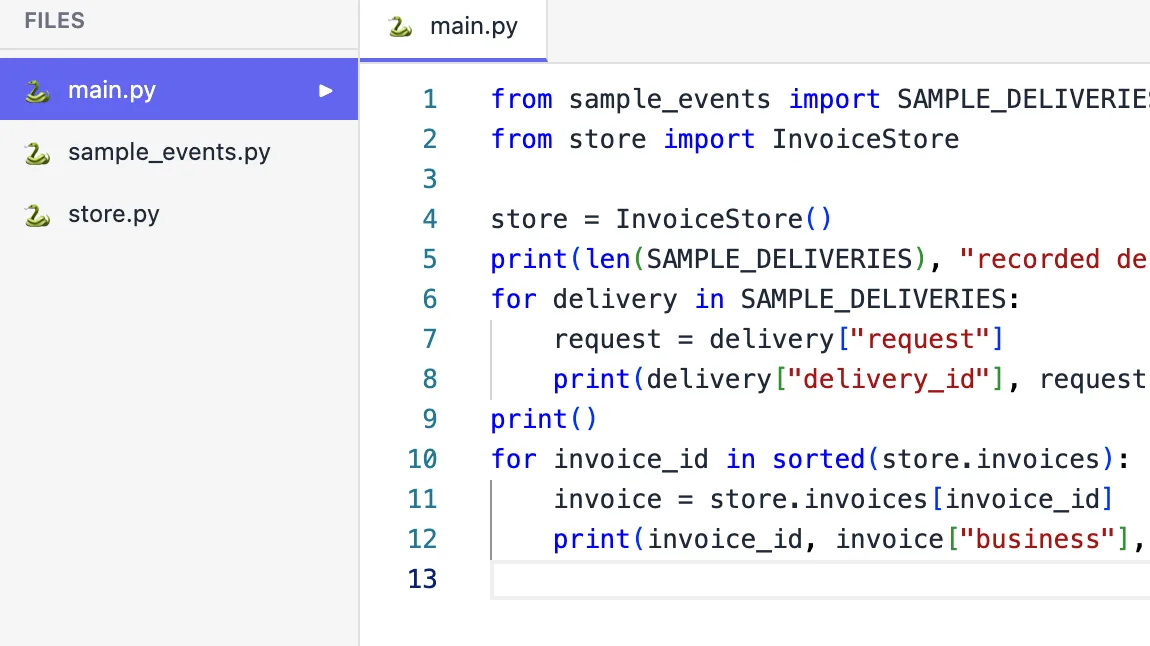
What a strong candidate did: Made the handler safe to receive the same event twice, ignored events that arrive out of order, and showed both reported bugs fixed with tests. The note told billing operations which past invoices to re-check.
A design on a whiteboard, then a written note
Nightly job ingestion from a partner scheduling API
Each night the product pulls changed jobs from a partner scheduling platform into PostgreSQL. At 06:00 a dispatch agent builds every business’s day plan from them, and dispatch teams start at 06:30. Jobs have been missing and duplicated.
What a strong candidate did: Designed an ingest that resumes from where it stopped, updates rather than duplicates, and finishes well before 06:00 with an alert if it will not. Named the one case that still needs a person to look.
How the decision gets made
With Gateway, each Java candidate gets situations written from your job description, such as a duplicate event that corrupts a record or a nightly import that misses data, and works on them in a real code editor or on a whiteboard, followed by a short written note. Your engineering manager sees a score and written feedback for each skill, can open the candidate's code read-only, and invites only the developers whose fixes and reasoning held up. The technical round then starts from real decisions the candidate already made.
See your next Java developer at work before you meet them
Paste your job description and Gateway writes the assessment in about 5 to 10 minutes. Your team can edit every question before it goes out.
Questions
Can the tasks reflect our stack, for example Spring Boot, Kafka and PostgreSQL?
Yes. The assessment is written from your job description, so it uses the frameworks, messaging and database your Java role actually mentions. Your team can read and change every question before any candidate sees it.
We are hiring a senior Java developer. Will this be too basic?
The situations follow the seniority in your job description. A senior candidate gets problems with trade-offs, such as an upgrade path or a concurrency fix that must not add latency, and the written note shows how the person reasons about risk.
How do our engineers review a candidate's code?
Every submission opens read-only in the same editor the candidate used, next to a score and written feedback per skill. Any engineer can change a score, and your team makes the final call.
What if a candidate copies an answer from the internet?
There is no question bank and no multiple choice, and the tasks come from your own role, so there is little to copy. Monitoring is off by default; if you turn it on, Gateway shows what happened and your team decides what it means.
Related