Hire a Ruby developer who writes Ruby the next person can follow
A Ruby developer is worth the seat when the Ruby code the developer writes is expressive without being clever, holds up in background workers and integrations, and survives Ruby version upgrades. Ruby lets two developers solve the same problem in very different ways, so the reliable way to compare candidates is to see each one write and fix real code before interviews.
What the hiring manager needs from a Ruby developer
Employers who ask for a Ruby developer rather than a Rails developer often have Ruby beyond the web app: background workers, integration services, internal gems, command-line tools and scripts that move data between systems. The engineering manager needs someone comfortable in all of it, including code that has no framework holding it together.
Metaprogramming nobody can follow
An internal gem defines methods at runtime with define_method and method_missing, and a bug hides somewhere inside. A good Ruby developer can trace it, and then replaces the magic with plain code where the cleverness was not earning its cost.
A Sidekiq worker that sends duplicates
A worker retries after a timeout and calls a partner API twice. The developer has to make the work safe to repeat with an idempotency key or a recorded state, so retries stop creating customer-facing mistakes.
A Ruby upgrade that breaks keyword arguments
Moving to Ruby 3 changes how keyword arguments are passed, and calls that worked for years start raising errors. Finding and fixing them across services and gems, with tests to prove it, is careful work the team depends on.
Memory that keeps growing in a long-running process
A worker process grows until it is killed and restarted. The developer has to find whether a cache, a global or a large object retained between runs is responsible, instead of scheduling more restarts.
Where hiring a Ruby developer usually goes wrong
- Hiring Rails experience for a Ruby role
- Rails hides much of the language behind conventions. A candidate who has only worked inside a Rails app may struggle with a plain Ruby service, a gem or a worker where those conventions do not exist.
- Rewarding the cleverest solution
- Ruby makes one-line tricks easy and attractive in interviews. On a team, code that a new hire can read in a minute is worth more than code that impresses once.
- Ignoring tests and how they are written
- Ruby teams lean heavily on RSpec or Minitest because the language checks so little before running. A candidate who writes code without tests, or with tests that only mirror the code, leaves the team exposed.
Real tasks from a Gateway assessment
These come from a Gateway assessment for a backend engineer, with the employer’s name taken out. Gateway writes every assessment from your own job description, so the tasks your candidates get are built around your role.
A design on a whiteboard, then a written note
Nightly job ingestion from a partner scheduling API
Each night the product pulls changed jobs from a partner scheduling platform into PostgreSQL. At 06:00 a dispatch agent builds every business’s day plan from them, and dispatch teams start at 06:30. Jobs have been missing and duplicated.
What a strong candidate did: Designed an ingest that resumes from where it stopped, updates rather than duplicates, and finishes well before 06:00 with an alert if it will not. Named the one case that still needs a person to look.
Code, then a short written note
Payment webhook handler for invoice updates
A billing product for home-services businesses learns about each payment from a provider webhook. Some homeowners got two receipts for one payment, and some paid invoices still show as unpaid. The candidate owns the handler.
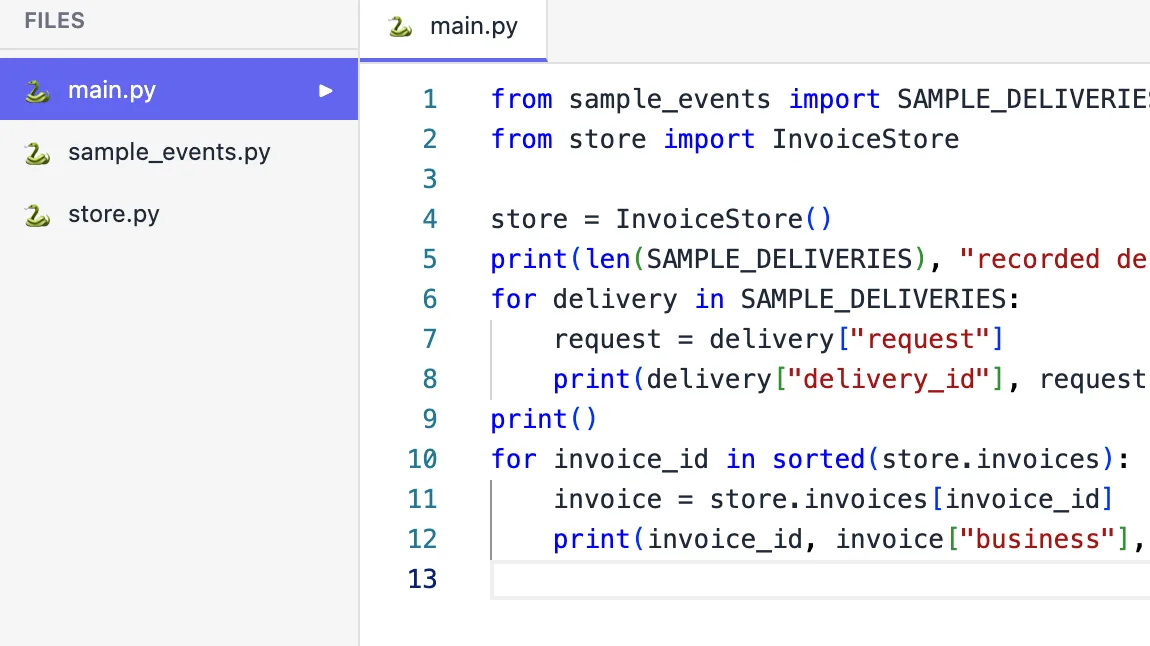
What a strong candidate did: Made the handler safe to receive the same event twice, ignored events that arrive out of order, and showed both reported bugs fixed with tests. The note told billing operations which past invoices to re-check.
How the decision gets made
In Gateway, each Ruby candidate gets situations written from your job description, such as designing a nightly import from a partner API that updates rather than duplicates and finishes on time, or fixing a webhook handler that sends two receipts for one payment. Candidates sketch the design or write the code, then add a short note. The engineering manager reads a score and feedback for every skill, opens the work read-only, and spends interview time only on developers whose Ruby was correct and readable.
See your next Ruby developer at work before you meet them
Paste your job description and Gateway writes the assessment in about 5 to 10 minutes. Your team can edit every question before it goes out.
Questions
Is this assessment different from the one for a Rails developer?
It is written from your role. A Ruby role with workers, gems and services gets situations outside the web framework, while a Rails role usually centres on ActiveRecord, controllers and the request cycle.
Can we include our own conventions, such as RSpec or Sorbet?
Yes. Mention them in the job description or edit the tasks directly. Your team can read and change every question before anyone receives it.
How do our engineers read a candidate's Ruby?
The candidate's code opens read-only in the same editor used during the task, next to the score and written feedback for each skill. Any reviewer can adjust a score.
Can we use this for a senior Ruby engineer?
Yes. Situations follow the seniority you describe, and the written note shows how the candidate weighs risk, such as which past records need a second look after a fix.
Related