Hire a Python developer whose code your team can trust with real data
A Python developer is worth hiring when the code handles the messy files, APIs and data a business actually has, fails loudly when something is wrong, and can be maintained by someone else. Python is easy to start and easy to write badly, so the way to tell candidates apart is to see each one work on a real data or automation problem before interviews.
What the hiring manager needs from a Python developer
Python roles cover a wide range: automation, integrations, internal tools, data processing and APIs. What the hiring manager usually needs is someone who takes a process that is fragile or done by hand and turns it into code that runs every day without supervision, and who can say clearly what the code does when it meets bad input.
A file from a partner that is never quite clean
A CSV arrives every morning with stray encodings, blank rows, dates in two formats and amounts with commas. A good Python developer writes checks for each case, holds back the bad rows with a reason someone can read, and keeps the good ones moving.
A script that became critical without anyone noticing
A one-off script written two years ago now runs every night from cron and other systems depend on its output. The developer has to add logging, tests and proper error handling without breaking the thing that already works.
Numbers that look wrong after a run
A report built from a pandas pipeline shows more customers than exist. The developer has to find where a merge duplicated rows or a type conversion silently changed values, then fix it so the next run cannot repeat the mistake.
Dependencies that break on a new machine
The code works on one laptop and fails on the server because of an unpinned package or a different Python version. Managing virtual environments, pinned requirements and packaging is a quiet part of the role that saves the team hours.
Where hiring a Python developer usually goes wrong
- Hiring on algorithm puzzles
- Many Python screens ask for list comprehensions and dictionary tricks against a timer. The real work is reading a broken file or a confusing API response and deciding what to do with it, and puzzles test none of that.
- Confusing data science with Python development
- A resume full of notebooks and model training can look like strong Python. Notebooks rarely show error handling, tests or code structure, which is what a developer maintaining production scripts needs most.
- Skipping the explanation to the business
- Python developers often work closely with finance, operations or analysts. A candidate who fixes the code but cannot tell finance which rows were held and why leaves the business user as confused as before.
- Accepting code that passes only on clean input
- A take-home built on a tidy sample file proves the happy path. Without a dirty file, you never see how the candidate treats the row that should stop the import.
Real tasks from a Gateway assessment
These come from a Gateway assessment for a Python developer, with the employer’s name taken out. Gateway writes every assessment from your own job description, so the tasks your candidates get are built around your role.
Python, then a short note for finance
Validate a payment-file import
Every morning the bank sends a CSV of yesterday’s incoming payments. A person has been cleaning it by hand, and a few bad rows reached billing unnoticed. Finance wants the checks in code before anything loads.
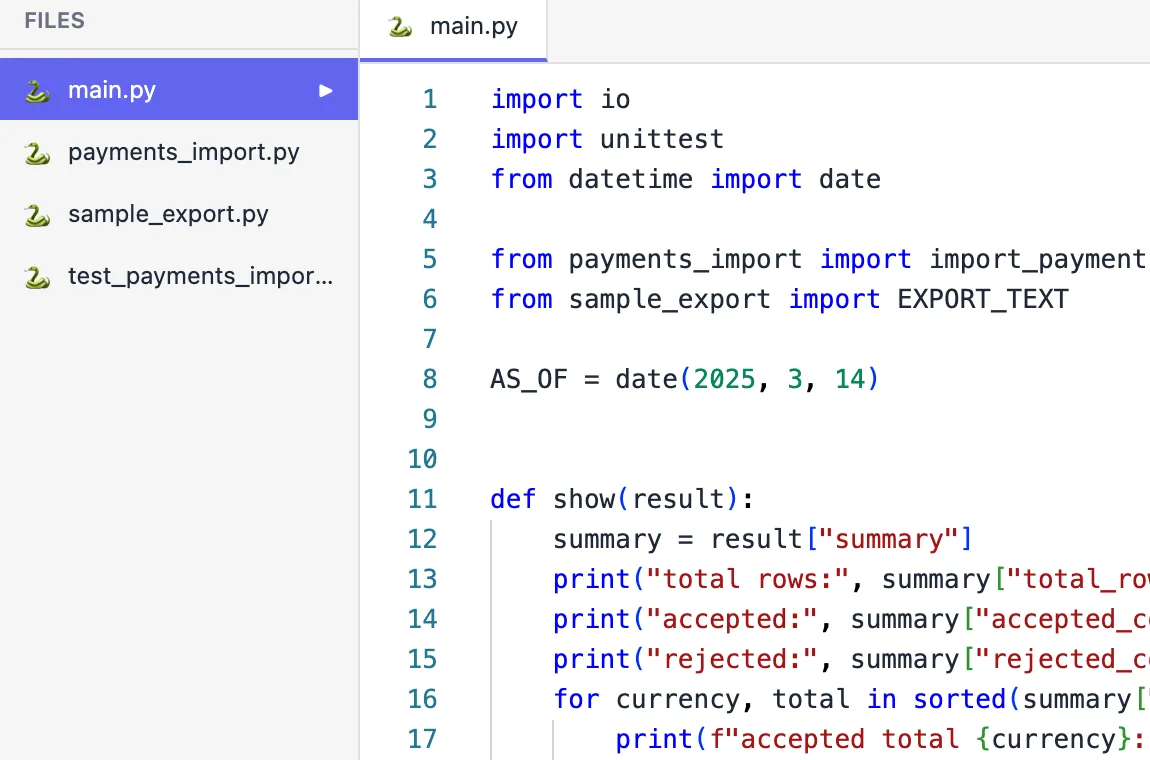
What a strong candidate did: Wrote checks for every bad-row case in the sample file, kept good rows flowing while holding bad ones with a reason finance can read, and tested each rule.
SQL on a copy of the billing data, then a note
Find and fix duplicate subscription charges
Since a billing run, several customers say they were charged twice. Finance wants to know how many customers and how much money before issuing any refunds.
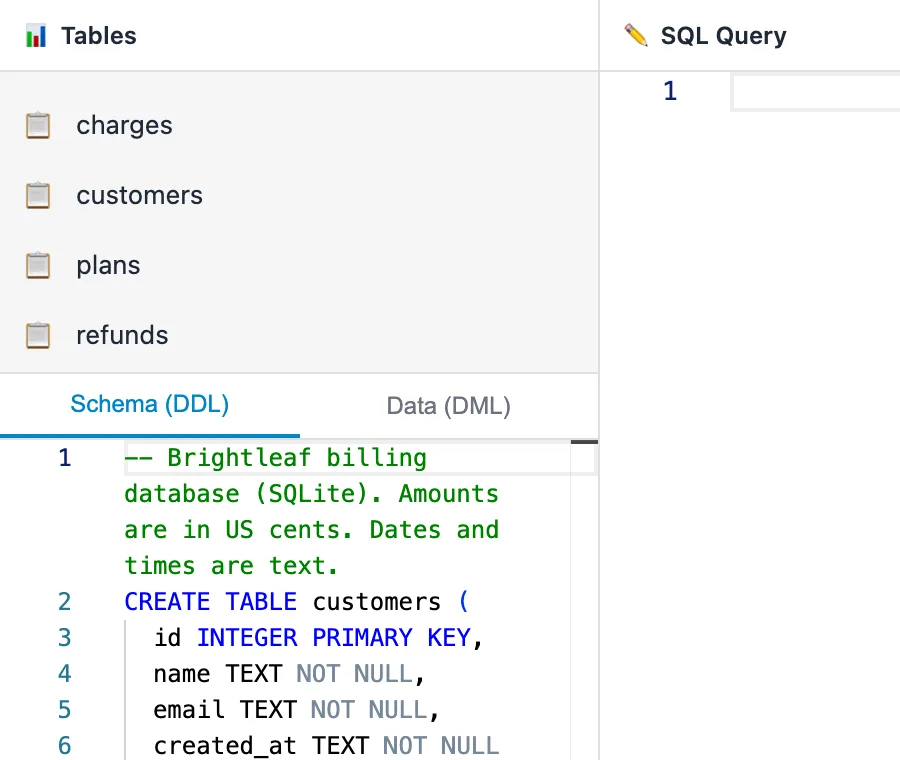
What a strong candidate did: Counted the affected customers and the exact amount, separated true duplicates from legitimate second charges, and explained the cause so it does not repeat next run.
How the decision gets made
With Gateway, each Python candidate works through situations from your job description, for example validating a payment file before it reaches billing or counting customers charged twice after a billing run. Candidates write Python or SQL against realistic data, then a short note for the business person who asked. The hiring manager sees a score and written feedback for each skill, opens the code and the note read-only, and interviews only those who caught the bad rows and explained the result clearly.
See your next Python developer at work before you meet them
Paste your job description and Gateway writes the assessment in about 5 to 10 minutes. Your team can edit every question before it goes out.
Questions
Can the assessment use pandas, FastAPI or other libraries we rely on?
Yes. Gateway writes the tasks from your job description, so the libraries your Python role names are the ones candidates use. Your team can edit any task and its sample data before sending.
Does it check code quality or only whether the output is right?
Both. Each skill gets a score with written feedback, so the hiring manager can see whether the candidate tested the rules, handled edge cases and wrote code a teammate could follow, as well as whether the result was correct.
We have many applicants for one Python role. How do we handle volume?
Add candidates from an ATS export, a spreadsheet or their resumes. Each candidate gets one link and a deadline, and you meet the people whose work is above the line you set.
Can we share a strong candidate's work with the hiring manager?
Yes. Results can be shared with a hiring manager along with a note, and the manager can open the candidate's code and written explanation in the same tool the candidate used.
Related